2026-07-24 東京科学大学
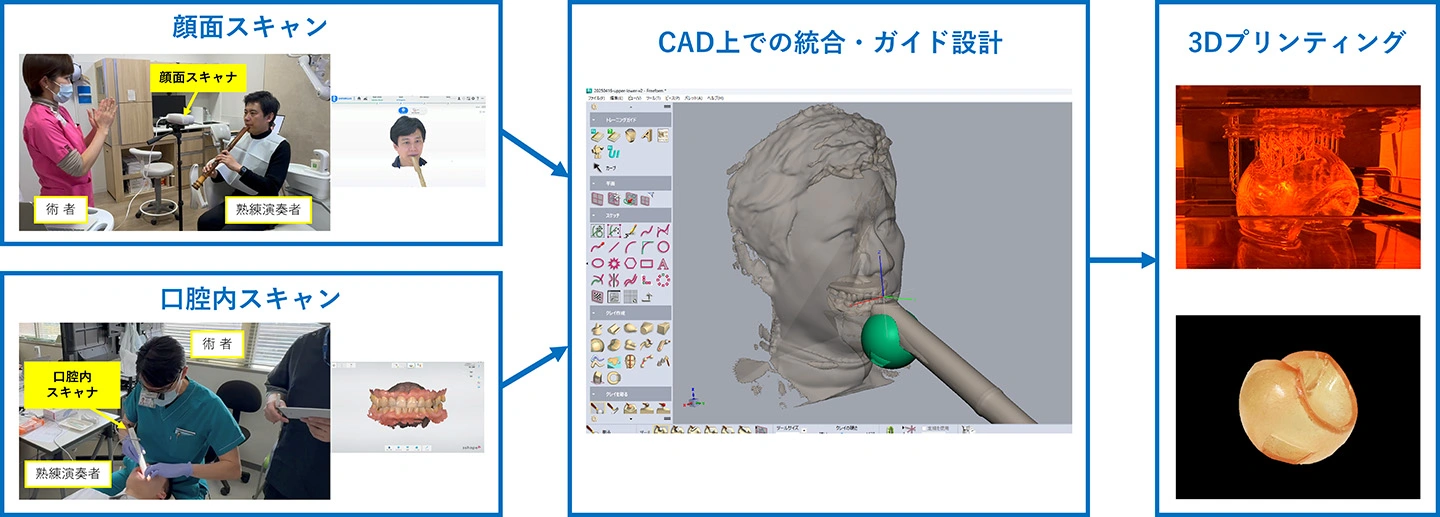
図1. エアリード楽器ガイドの製作ワークフロー
<関連情報>
- https://www.isct.ac.jp/ja/news/ka7w7d9irq2a
- https://www.jstage.jst.go.jp/article/jpr/advpub/0/advpub_JPR_D_25_00340/_article
補綴用デジタルガイドワークフローの拡張による唇と物体の空間的関係の再現:エアリード楽器への応用 Extension of prosthodontic digital guide workflow to reproduce lip–object spatial relationships: Application to an air-reed instrument
Tamaki Hada , Dozan Fujiwara, Maiko Iwaki, Masanao Inokoshi, Manabu Kanazawa
Journal of Prosthodontic Research Published:July 11, 2026
DOI:https://doi.org/10.2186/jpr.JPR_D_25_00340
Abstract
Purpose: This study aimed to extend the prosthodontic digital guide concept beyond intraoral applications by developing a method to capture and reproduce extraoral perioral spatial relationships using a digitally fabricated positioning guide in a proof-of-concept case.
Methods: An air-reed musical instrument guide was developed to digitally record and replicate the target distance and angulation between the lips and instrument. Facial and intraoral scans were obtained from an experienced shakuhachi player using a face scanner and an intraoral scanner. The integrated 3D datasets were manually aligned using CAD software using anatomical reference landmarks and used to design a positioning guide by applying principles similar to those used in the fabrication of surgical guides. The guide was designed as a hollow structure and was exported in a Standard Tessellation Language file format. It was fabricated using a stereolithography 3D printer with a photopolymer material commonly employed in dental surgical guides, followed by post-curing and surface polishing. Preliminary usability and fit were assessed through a practical application by the musician and a self-evaluation questionnaire using six categories rated on a 10-point scale. No objective validation of the positional accuracy or reproducibility was performed.
Conclusions: The proposed digital workflow demonstrates the feasibility of fabricating a positioning guide for recording and transferring lip–instrument relationships in this proof-of-concept case. This approach suggests the potential applicability of prosthodontic digital guide concepts for capturing and reproducing extraoral perioral spatial positioning.