2026-07-24 ワシントン大学セントルイス校
<関連情報>
- https://source.washu.edu/2026/07/bateman-horie-recognized-for-method-to-detect-stage-alzheimers-disease/
- https://www.nature.com/articles/s41591-025-03617-7
血漿MTBR-tau243バイオマーカーはアルツハイマー病におけるタウタンパク質凝集病理を特定する Plasma MTBR-tau243 biomarker identifies tau tangle pathology in Alzheimer’s disease
Kanta Horie,Gemma Salvadó,Rama K. Koppisetti,Shorena Janelidze,Nicolas R. Barthélemy,Yingxin He,Chihiro Sato,Brian A. Gordon,Hong Jiang,Tammie L. S. Benzinger,Erik Stomrud,David M. Holtzman,Niklas Mattsson-Carlgren,John C. Morris,Sebastian Palmqvist,Rik Ossenkoppele,Suzanne E. Schindler,Oskar Hansson & Randall J. Bateman
Nature Medicine Published:31 March 2025
DOI:https://doi.org/10.1038/s41591-025-03617-7
Abstract
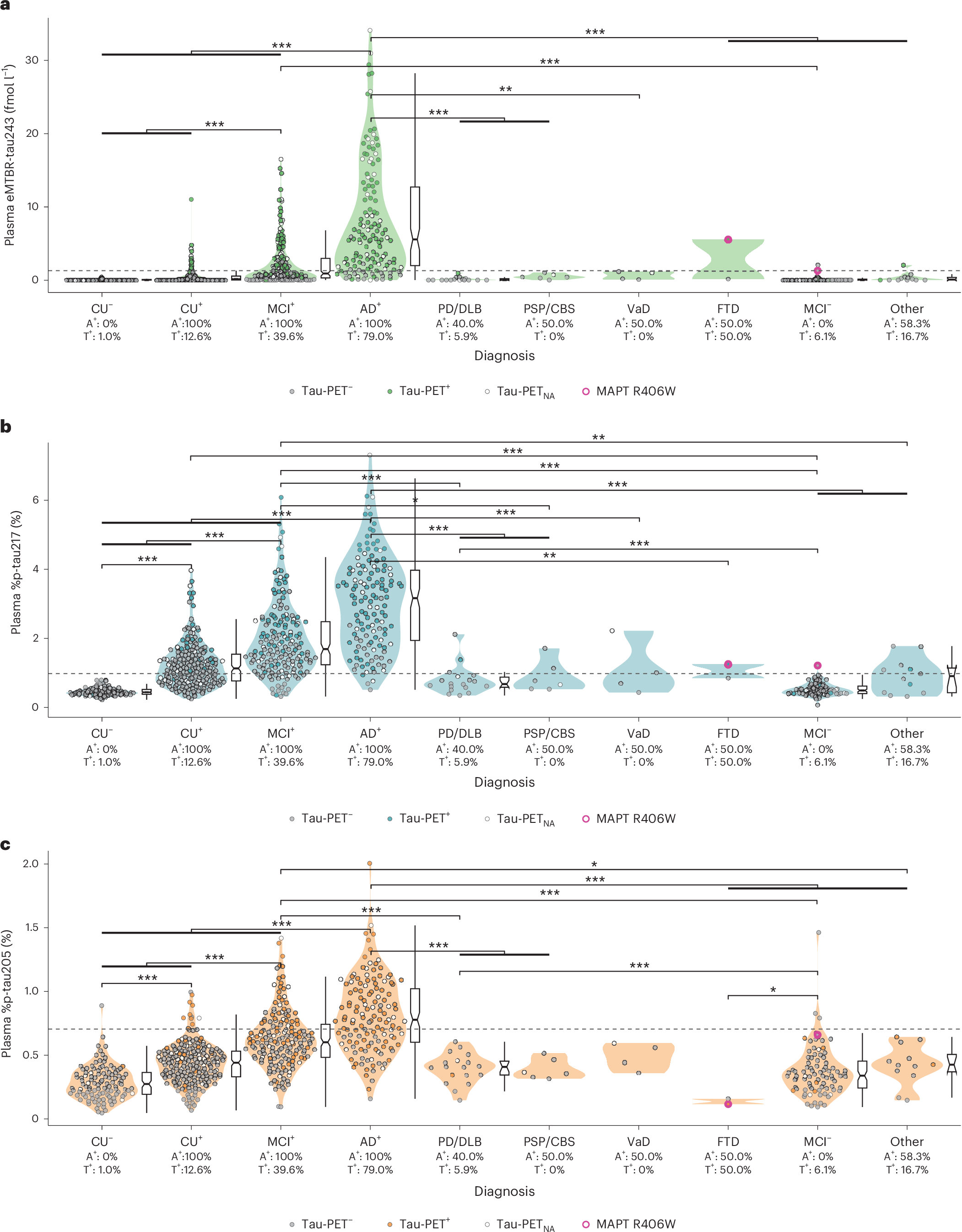
Insoluble tau aggregates within neurofibrillary tangles are a defining neuropathological feature of Alzheimer’s disease (AD) and closely correlate with clinical symptoms. Although tau pathology can be assessed using tau positron emission tomography, a more accessible biomarker is needed for diagnosis, prognosis and tracking treatment effects. Here we present a new plasma tau species, the endogenously cleaved, microtubule-binding region containing residue 243 (eMTBR-tau243), which specifically reflects tau tangle pathology. Across the AD spectrum in three different cohorts (n = 108, 55 and 739), plasma eMTBR-tau243 levels were significantly elevated at the mild cognitive impairment stage and increased further in dementia. Plasma eMTBR-tau243 showed strong associations with tau positron emission tomography binding (β = 0.72, R2 = 0.56) and cognitive performance (β = 0.60, R2 = 0.40), outperforming other plasma tau (%p-tau217 and %p-tau205) biomarkers. These results suggest that plasma eMTBR-tau243 may be useful for estimating the tauopathy load in AD, thereby improving the diagnostic evaluation of AD in clinical practice and monitoring the efficacy of tau-targeted therapies in clinical trials.