2026-07-30 東京大学
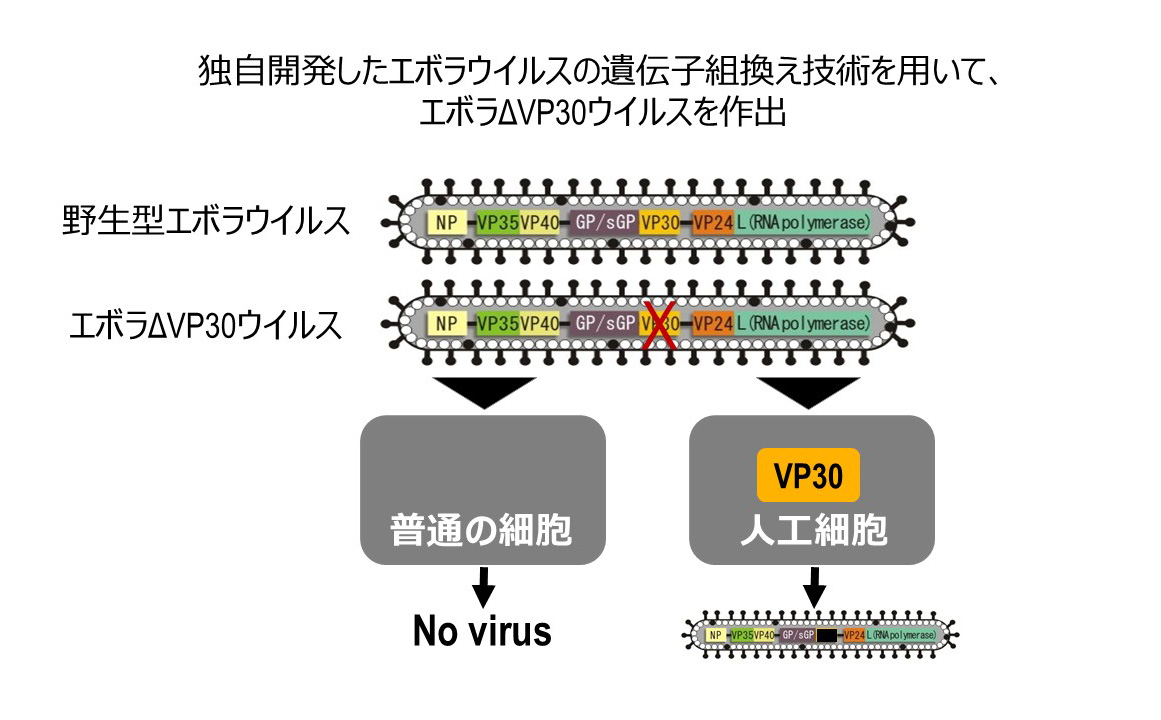
図1 エボラΔVP30ウイルスとは?
<関連情報>
- https://www.u-tokyo.ac.jp/focus/ja/press/z0406_00016.html
- https://www.nejm.org/doi/10.1056/NEJMc2518666
iEvac-Z、不活化エボラワクチン ― 日本における第1相臨床試験 iEvac-Z, an Inactivated Ebola Vaccine — Phase 1 Study in Japan
Tokiko Watanabe, D.V.M., Ph.D.;Michiko Koga, M.D., Ph.D.;Masanori Nojima, M.D., Ph.D.;Minako Kono, M.S.;Yuriko Tomita, Ph.D.;Tadashi Maemura, D.V.M., Ph.D.;Itsuki Anzai, Ph.D.;Yuri Furusawa, Ph.D.;Calvin Duong, Ph.D.;Yoichiro Kino, Ph.D.;Peter J. Halfmann, Ph.D.;Fumitaka Nagamura, M.D., Ph.D.;Hiroshi Yotsuyanagi, M.D., Ph.D.Yoshihiro Kawaoka, D.V.M., Ph.D.
New England Journal of Medicine Published: July 29, 2026
DOI: 10.1056/NEJMc2518666
To the Editor:
Ebola virus (EBOV) disease continues to pose a major global health threat, with recurrent outbreaks underscoring the need for effective vaccination strategies.1 Although currently licensed EBOV vaccines are effective, safety concerns have been raised owing to the replication-competent nature of the viral vectors used and associated adverse events.2,3 We developed iEvac-Z, an inactivated whole-virus EBOV vaccine derived from replication-deficient EBOV lacking VP30, a gene that encodes an essential viral transcription factor (EBOVΔVP30).4 This virus cannot replicate outside VP30-complementing cells and can be manufactured under biosafety level 2 conditions. Subsequent inactivation with β-propiolactone ensures loss of infectivity while preserving the full viral antigen repertoire, including glycoprotein, nucleoprotein, and VP40. In a study in nonhuman primates, this vaccine provided protection against a lethal challenge.5