2026-07-29 イェール大学
<関連情報>
- https://news.yale.edu/2026/07/29/climate-change-likely-worsening-childhood-malaria-study-finds
- https://www.nature.com/articles/s41586-026-10840-w
気候変動がアフリカの小児マラリアに及ぼす過去および将来の影響 The past and future impact of climate change on childhood malaria in Africa
Colin J. Carlson,Tamma Carleton,Romaric C. Odoulami,Cullen D. Molitor & Christopher H. Trisos
Nature Published:29 July 2026
DOI:https://doi.org/10.1038/s41586-026-10840-w
Abstract
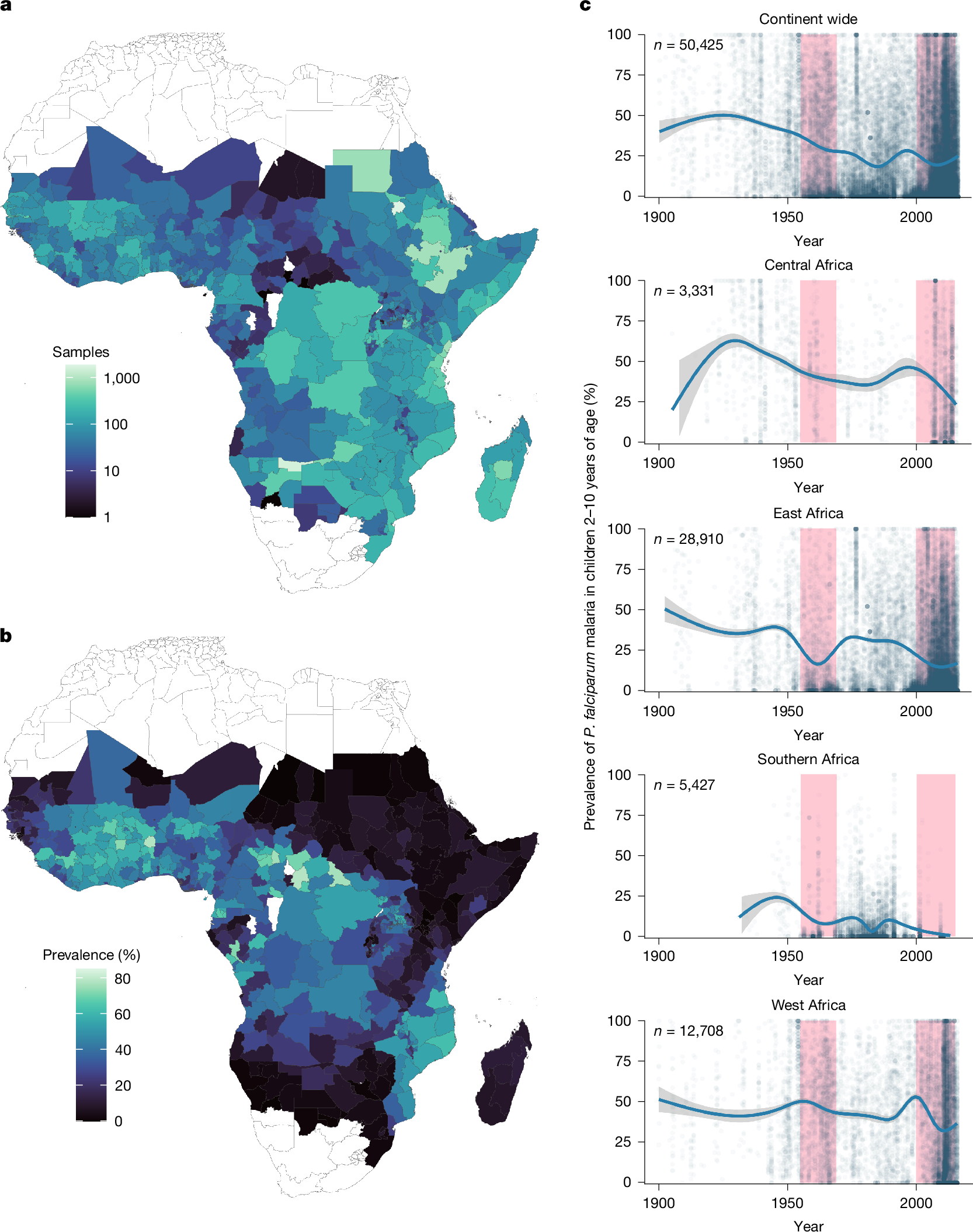
Despite recent advances in climate change attribution, many health impacts remain unmeasured1. Here we leverage over a century of clinical data2 to investigate whether human-caused climate change has increased the burden of childhood malaria across sub-Saharan Africa. We find a robust effect of temperature and extreme precipitation on prevalence, consistent with previous findings at local scales and in laboratory experiments. We estimate that rising temperatures have probably increased malaria in East and southern Africa, but averted a comparable number of cases in West Africa, with a net impact of 1 excess case per 1,000 children (95% confidence interval (CI) −4 to 6) across the continent. Over the coming century, we project that climate change could marginally accelerate the elimination of malaria in West and central Africa, where the present-day burden is highest; across the continent, this could avert 1 (low greenhouse gas emissions: 95% CI −2 to 6) to 20 (high greenhouse gas emissions: 95% CI 0–52) cases per 1,000 children by the end of the century. However, reducing future global warming from 3 °C to under 2 °C could prevent an average of 5 excess cases per 1,000 in high-elevation (more than 1 km) East Africa and in southern Africa (95% CIs −3 to 13 and −4 to 14, respectively) by 2100. Our study resolves a decades-old debate about one of the first suspected health impacts of climate change, providing a template for future work measuring its true global burden.