2026-08-06 琉球大学
<関連情報>
2つのストレス応答キナーゼは、軽度の酸化ストレス下で抗酸化プログラムを活性化することでフェロトーシスを抑制する Two stress-responsive kinases suppress ferroptosis by activating antioxidant programs under mild oxidative stress
Yumiko Fujikawa,Hirotatsu Imai,Tetsuo Onuki,Kouji Hoshino,Marco A. De Velasco,Kazuhiko Matsuo,Hitomi Kurosawa,Kyoko Aoyagi,Hiroko Hirose,Yoshie Nakamura,Akiko Uchiyama,Kae Suzuki,Mariko Mizuguchi,Hidehisa Takahashi,Hiroyuki Osada,Noritaka Kagaya,Kazuo Shin-ya,Hiroyuki Satofuka,Yukinari Kato,Hidehito Kuroyanagi,Daisuke Utsumi,Kenzo Takahashi,Takashi Nakayama,Hirotsugu Uemura,… Akio Yamashita
Signal Transduction and Targeted Therapy Published:03 August 2026
DOI:https://doi.org/10.1038/s41392-026-02892-1
Abstract
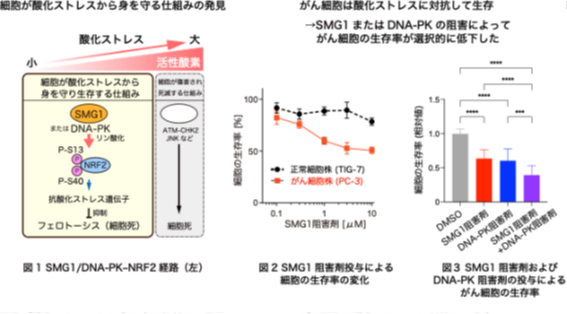
Cancer cells maintain chronically elevated levels of reactive oxygen species (ROS) while relying on robust antioxidant programs to preserve redox homeostasis and viability. Although therapeutic strategies that disrupt this balance to induce lethal oxidative stress and ferroptosis have emerged as promising anticancer approaches, the upstream signaling mechanisms that constrain ROS accumulation under physiologically relevant stress conditions remain incompletely understood. Here, we identify the stress-responsive kinases SMG1 and DNA-dependent protein kinase (DNA-PK) as functionally redundant regulators of redox homeostasis and ferroptosis resistance. Genetic or pharmacological inhibition of either kinase triggers ferroptotic cell death, accompanied by marked accumulation of total ROS, ferrous iron, and lipid hydroperoxides. Mechanistically, under mild oxidative stress, SMG1 and DNA-PK cooperatively phosphorylate the central antioxidant transcription factor NRF2 at serine 13 and serine 40, weakening its interaction with the negative regulator KEAP1 and promoting NRF2 accumulation and transcriptional activation. Transcriptomic profiling of de novo mRNAs revealed that inhibition of either kinase is sufficient to suppress NRF2-driven antioxidant gene expression. In contrast, excessive oxidative stress overrides this pro-survival pathway and redirects signaling toward anti-survival responses mediated by ATF4, ATM–CHK2, and JNK/p38 pathways. Collectively, these findings uncover a previously unrecognized SMG1/DNA-PK–NRF2 signaling axis that functions as a redox stress–intensity–dependent switch governing cell fate decisions between antioxidant adaptation and ferroptotic death. Targeting this axis may represent a promising therapeutic strategy for cancer treatment.