2026-08-07 京都大学
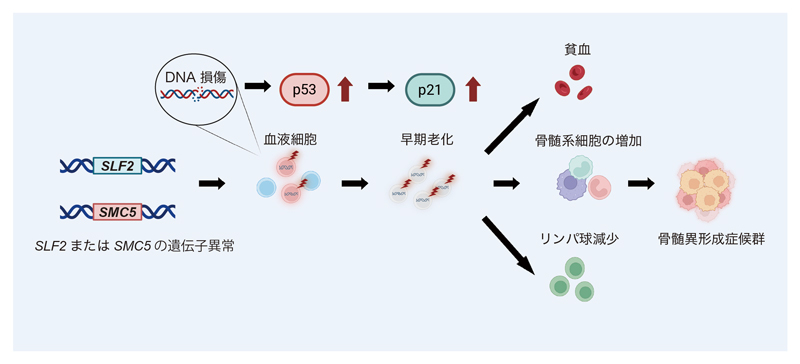
SLF2およびSMC5遺伝子の異常による骨髄不全症の発症メカニズム。図はBioRenderで作成。作者: Sho Shibata
<関連情報>
- https://www.kyoto-u.ac.jp/ja/research-news/2026-08-07
- https://www.nature.com/articles/s41375-026-03061-7
SLF2とSMC5の機能不全は造血幹細胞の老化を促進し、骨髄異形成症候群(MDS)の発症リスクを高めることから、新たな遺伝性骨髄不全症候群が定義される SLF2 and SMC5 dysfunction drives HSC aging and predisposes to MDS, defining a new inherited bone marrow failure syndrome
Sho Shibata,Kazuhisa Chonabayashi,Hirofumi Nakamura,Yasuko Matsumura,Hiroki Kawahara,Yoshio Okamoto,Shohei Yamamoto,Misato Nishikawa,Yotaro Ochi,Yuri Uchiyama,Yukiko Oh,Akitsu Hotta,Kenta Masuda,Naomichi Matsumoto,Seishi Ogawa,Yoshinori Yoshida & Akifumi Takaori-Kondo
Leukemia Published:07 August 2026
DOI:https://doi.org/10.1038/s41375-026-03061-7
Abstract
Inherited bone marrow failure syndromes (IBMFS) comprise a heterogeneous group of genetic disorders and are associated with an increased risk of myelodysplastic syndromes (MDS). We and others recently identified pathogenic variants in SLF2 and SMC5 as the cause of Atelis Syndrome, a neurodevelopmental disorder accompanied by hematological abnormalities, including anemia and lymphopenia. However, the mechanisms underlying the associated hematopoietic dysfunction remain unclear. Through longitudinal follow-up and re-evaluation, we found that some patients developed MDS at a young age. To elucidate the bases of these hematopoietic defects, we analyzed hematopoietic progenitor cells (HPCs) derived from patient-specific induced pluripotent stem cells harboring compound heterozygous SLF2 mutations. Mutant HPCs exhibited impaired colony-forming capacity, defective erythroid differentiation with a myeloid bias, and markedly reduced engraftment in xenotransplantation assays. SMC5 knockdown in cord blood CD34+ cells impaired colony formation. Mechanistically, disruption of the SLF2–SMC5 axis induced genomic instability, p53/p21 activation, and a senescence-like phenotype. ATAC sequencing revealed epigenetic features characteristic of hematopoietic stem cell (HSC) aging, including increased chromatin accessibility at PU.1 motifs associated with myeloid bias. These findings demonstrate that SLF2 and SMC5 dysfunction drives premature HSC aging, bone marrow failure, and predisposition to MDS, revealing Atelis Syndrome as a previously unrecognized IBMFS.