2026-08-07 東京大学
脳の老廃物排出システムの活性化でタウ病理を改善
<関連情報>
- https://www.h.u-tokyo.ac.jp/press/20260807.html
- https://www.h.u-tokyo.ac.jp/press/__icsFiles/afieldfile/2026/08/07/release_20260807.pdf
- https://link.springer.com/article/10.1186/s13024-026-00977-7
AQP4依存的なグリンパティック機能の増強は、PS19マウスにおけるタウ病理および神経変性を軽減する AQP4-dependent enhancement of glymphatic function attenuates tau pathology and neurodegeneration in PS19 mice
Kaoru Yamada,Kazuhisa Ishida,Asami Sakamoto,Hitoshi Shimada,Masaki Watanabe,Masato Shimojo,Hironaka Igarashi & Takeshi Iwatsubo
Molecular Neurodegeneration Published:18 July 2026
DOI:https://doi.org/10.1186/s13024-026-00977-7
Abstract
Background
The glymphatic system facilitates cerebrospinal fluid–interstitial fluid exchange and contributes to the clearance of pathogenic proteins from the brain. Glymphatic dysfunction has been associated with Alzheimer’s disease and related tauopathies; however, whether impaired glymphatic transport causally drives tau accumulation and neurodegeneration, and whether its enhancement confers therapeutic benefit, remains unclear.
Methods
Glymphatic water dynamics in PS19 tau transgenic mice were assessed using JJVCPE, a novel MRI-based approach for evaluating brain water exchange. The effect of pharmacological activation of aquaporin-4 (AQP4) with TGN-073 on glymphatic cerebrospinal fluid influx was examined in wild-type mice using dynamic contrast–enhanced MRI. Tau pathology, neurodegeneration, and cerebrospinal fluid tau levels were analyzed in PS19 mice following chronic TGN-073 treatment. AQP4-deficient PS19 mice were examined to determine target specificity.
Results
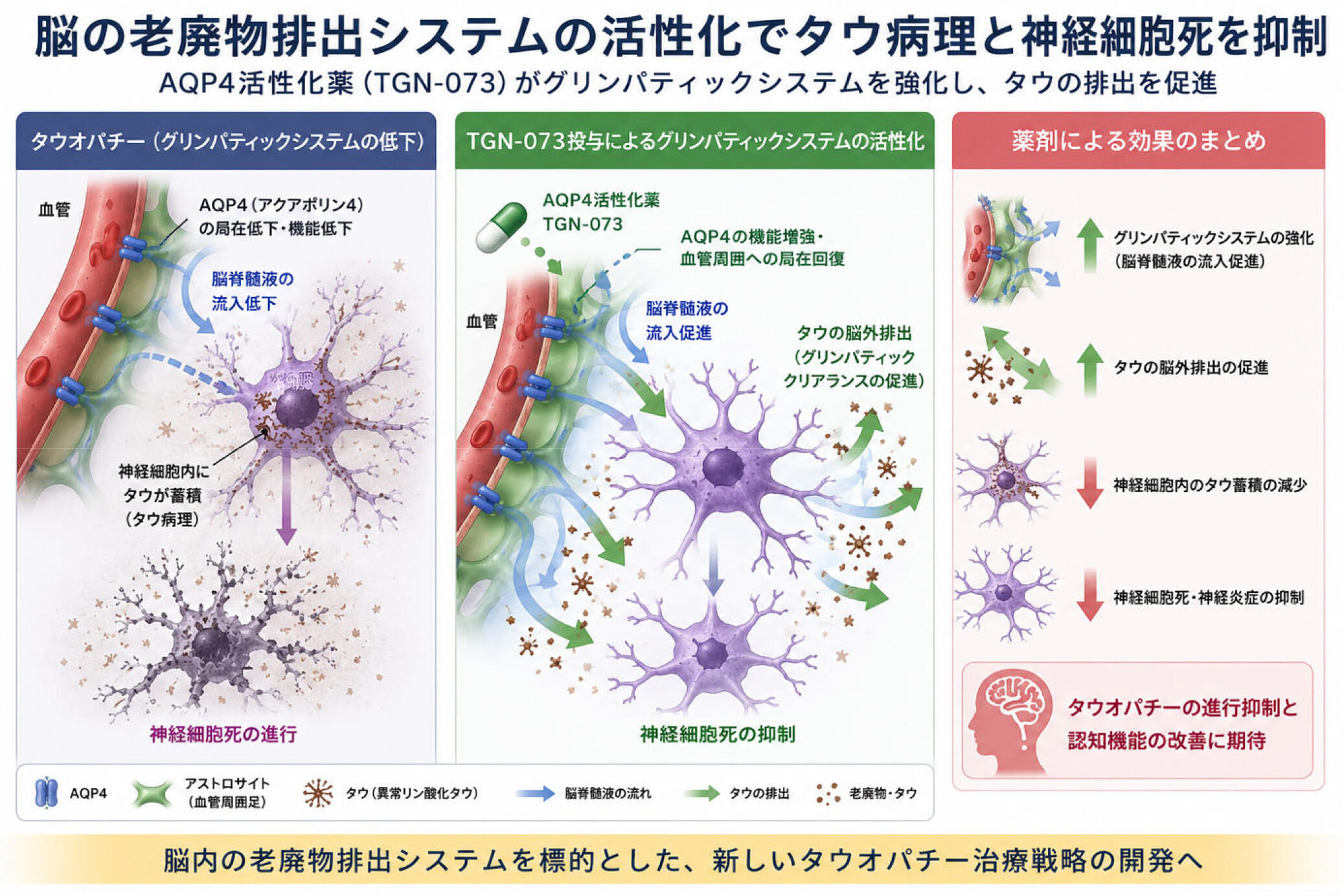
PS19 mice exhibited significant impairment of glymphatic water exchange at early disease stages, which progressively worsened with ageing. Pharmacological activation of AQP4 with TGN-073 robustly enhanced glymphatic-related tracer influx, reduced tau accumulation, neuronal loss, and gliosis, and was accompanied by increased cerebrospinal fluid tau levels. TGN-073 also restored perivascular AQP4 enrichment without significantly altering overall AQP4 abundance. Importantly, these beneficial effects were abolished in AQP4-deficient PS19 mice, demonstrating that both glymphatic enhancement and suppression of tau pathology and neurodegeneration are AQP4-dependent.
Conclusions
Our findings support a mechanistic contribution of impaired glymphatic function to tau accumulation and neuronal vulnerability in tauopathy. Pharmacological activation of AQP4 enhances glymphatic function, restores perivascular AQP4 organization, and ameliorates tau pathology, neurodegeneration, and gliosis. These findings identify AQP4-mediated glymphatic modulation as a disease-relevant and therapeutically tractable pathway for tau-related neurodegenerative disorders.