2026-08-20 バージニア工科大学(Virginia Tech))
<関連情報>
- https://news.vt.edu/articles/2026/07/cnre-bears-hibernating-patterns.html
- https://royalsocietypublishing.org/rspb/article/293/2072/20260374/481983/Untangling-the-influence-of-ambient-temperature
アメリカクロクマ(Ursus americanus) の冬眠活動における周囲温度と日長の影響の解明 Untangling the influence of ambient temperature and photoperiod surrounding hibernation activity in American black bears (Ursus americanus)
Brogan Elizabeth Holcombe;J. Bernardo Mesa-Cruz;Marcella Kelly
Proceedings of the Royal Society B Published:03 Jun 2026
DOI:https://doi.org/10.1098/rspb.2026.0374
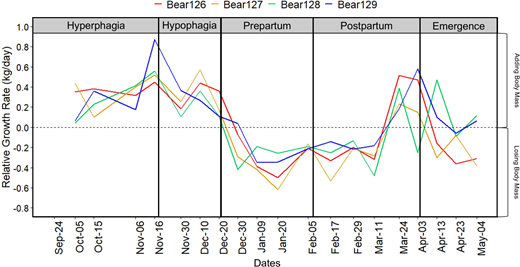
Abstract
Hibernation behavioural ecology remains understudied due to challenges in researching this cryptic physiological state. However, understanding relationships between physiological and environmental cues during hibernation is important for predicting behaviours in a changing climate. We examined behaviours of temporarily captive American black bears (Ursus americanus) exposed to natural environmental fluctuations surrounding hibernation. We analysed 22 000+ hours of continuous video recordings of four female black bears, categorizing 45 behaviours. We used generalized linear mixed models and AIC model selection to analyse behaviours in relation to environmental (e.g. temperature, photoperiod) and physiological (e.g. body mass changes, hibernation stages) factors. We found a strongly supported interaction between photoperiod and temperature in 3 of 5 physiological stages in driving active behaviours, revealing potential drivers for hibernation onset and arousal. Photoperiod and temperature influenced activity levels, particularly during hyperphagia and den emergence, while temperature alone influenced activity during hibernation onset. Thus, predicted increases in temperatures due to climate change could lead to increased activity, especially surrounding hibernation onset. To our knowledge, no studies have investigated the interplay between photoperiod and temperature in bear hibernation ecology. We also highlight the potential for a mismatch between physiology and environmental cues in areas projected to experience increased temperatures under a changing climate.