2026-09-03 弘前大学
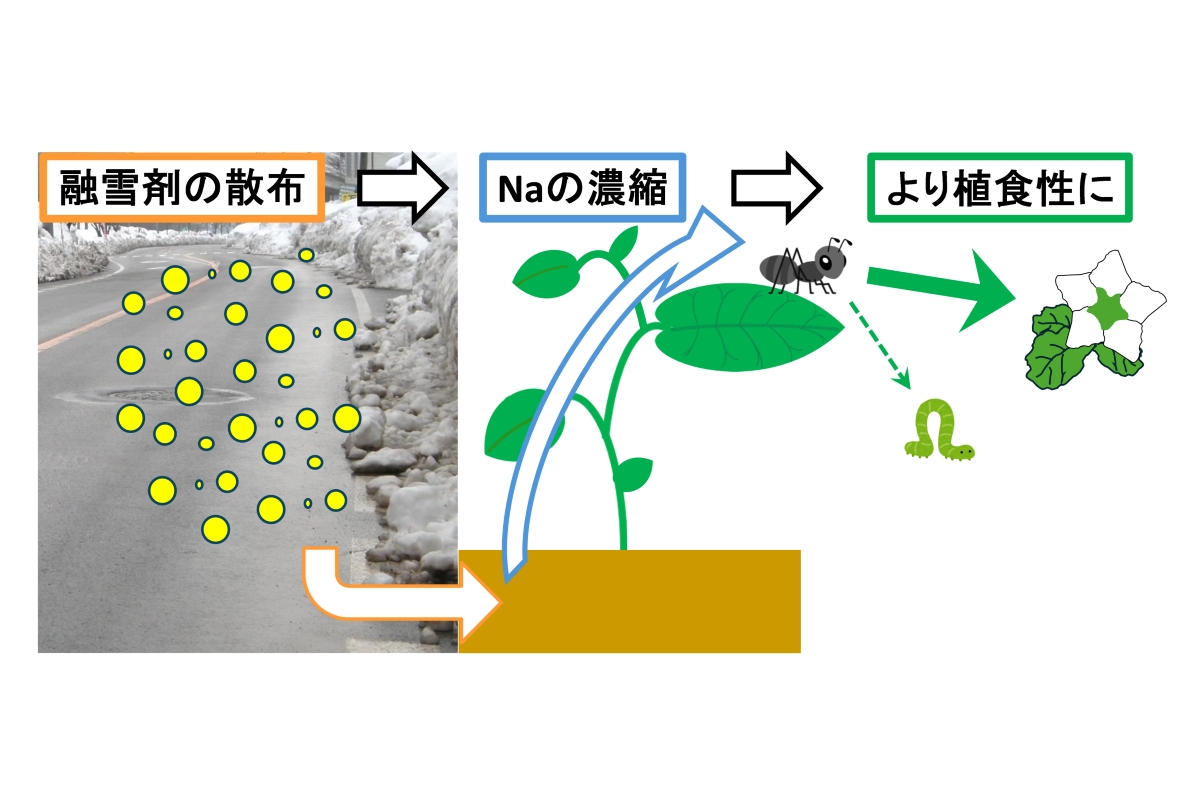
図1. 本研究によって明らかにされたこと
<関連情報>
- https://www.hirosaki-u.ac.jp/topics/116824/
- https://www.sciencedirect.com/science/article/pii/S0929139326006372
道路に散布される塩は、路傍の植物やアリのナトリウム濃度を上昇させ、三栄養段階間の相互作用を変化させる Road salt application increases sodium levels in roadside plants and ants, reshaping tritrophic interactions
Hiroki Terajima, Youhei Kawase, Akira Yamawo, Nobuyuki Azuma, Kaori Noda, Hiroshi Ikeda
Applied Soil Ecology Available online: 31 August 2026
DOI:https://doi.org/10.1016/j.apsoil.2026.107417
Highlights
- Sodium concentrations in soil and plants increased near the national route in spring.
- Sodium concentrations of ants also increased closer to the national route in spring.
- Ants acclimated to high-sodium baits gathered at the low-sodium baits.
- The trophic level of ants was lower near the national route in spring.
Abstract
In areas with heavy snowfall and high anthropogenic activity, a large amount of sodium chloride is applied in winter as an antifreezing agent for the road surface. The effects of road salt application may be widespread among various plants and high-trophic-level organisms. Here, we examined the effects of road salt application on plants (Japanese knotweed, white clover, and bitter dock) and omnivorous ants. Ten study sites were established along a main national route in the northwestern region of Japan. We examined the accumulation of sodium in soil, plants, and ants near the national route. We also tested the change in the trophic level of ants in a high‑sodium environment due to the change in the preference for the sodium concentration of baits by conducting a rearing experiment and nitrogen stable isotope analysis. The concentrations of sodium in the soil, leaves of Japanese knotweed and white clover, the extrafloral nectar of Japanese knotweed and ants increased closer to the national route in spring. Ants acclimated to high‑sodium baits gathered at the low-sodium baits, indicating that road salt application changed the food preference of the ants and that the ants increasingly preferred low-sodium foods. The trophic level of ants was lower the closer they were to the national route in spring, suggesting that ants became more herbivorous near the national route, favouring lower-sodium food at lower-trophic levels. Our study revealed that road salt application can change insect behaviour through sodium accumulation, leading to changes in biological interactions such as predator–prey relationships.