2026-09-05 量子科学技術研究開発機構
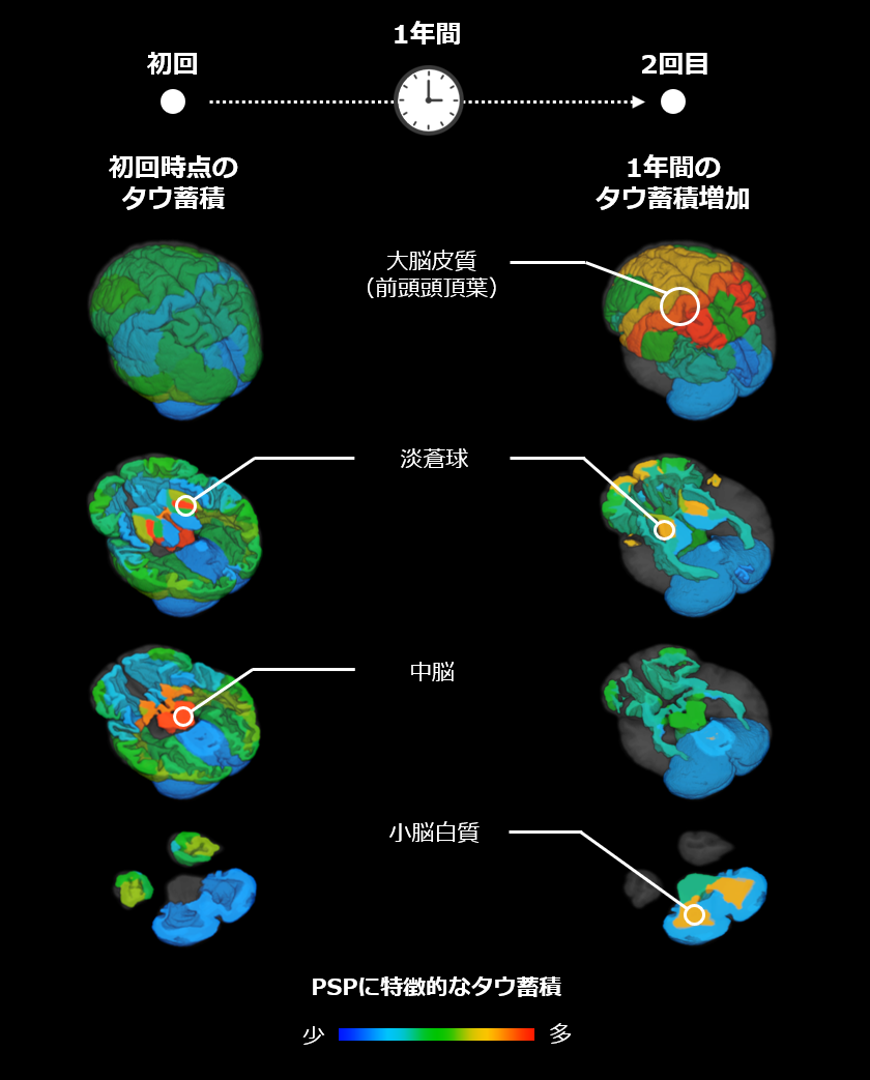
図1.PSPに特徴的なタウ蓄積領域
<関連情報>
- https://www.qst.go.jp/site/press/20260905.html
- https://movementdisorders.onlinelibrary.wiley.com/doi/10.1002/mds.70468
時空間的なタウ蓄積と進行性核上性麻痺への臨床的影響:縦断的フロルゾロタウ(18F)陽電子放出断層撮影 Spatiotemporal Tau Accumulation and its Clinical Impact on Progressive Supranuclear Palsy: Longitudinal Florzolotau (18F) Positron Emission Tomography
Yoshikazu Chishiki MD, MEng, Kenji Tagai MD, PhD, Yuko Kataoka MD, PhD, Ryoji Goto MD, Kenta Osawa MD, Asaka Oyama MSc, Hideki Matsumoto DDS, PhD …
Movement Disorders Published: 04 September 2026
DOI:https://doi.org/10.1002/mds.70468
Abstract
Background
Florzolotau (18F) positron emission tomography (florzolotau PET) enables high-contrast in vivo detection of four-repeat tau pathology in progressive supranuclear palsy (PSP), but whether longitudinal tau imaging reflects disease progression remains unclear.
Objectives
To explore longitudinal tau accumulation using florzolotau PET and evaluate its association with clinical progression in PSP.
Methods
Twenty-six patients with PSP (18 Richardson’s syndrome [PSP-RS], 8 non-RS) and 10 age- and sex-matched healthy controls (HCs) underwent florzolotau PET, magnetic resonance imaging, and clinical assessments at baseline and after 1 year. Regional standardized uptake value ratios (SUVRs) were extracted across 57 regions of interest. Partial least squares (PLS) multivariate analyses revealed regions with elevated baseline SUVR and longitudinal increase (ΔSUVR) in PSP relative to HCs, alongside regions where ΔSUVR was associated with changes in PSP Rating Scale scores.
Results
At baseline, tau deposition was most prominent in the globus pallidus (GP) and midbrain in patients with PSP. Longitudinal tau increases were observed in the GP, frontoparietal cortex, and cerebellar white matter, and minimal progression was observed in the midbrain. GP tau accumulation exhibited the strongest association with clinical progression in the PLS model among PSP-RS and a univariate correlation (Spearman’s ρ = 0.688, P = 0.002).
Conclusions
This study provides in vivo evidence of the spatiotemporal progression of tau pathology in PSP. In the GP, tau accumulation emerges early and continues to increase with clinical deterioration. These findings support the utility of florzolotau PET for monitoring disease progression and as a biological outcome measure in tau-targeted therapeutic trials. © 2026 The Author(s). Movement Disorders published by Wiley Periodicals LLC on behalf of International Parkinson and Movement Disorder Society.