2026-09-09 国立遺伝学研究所
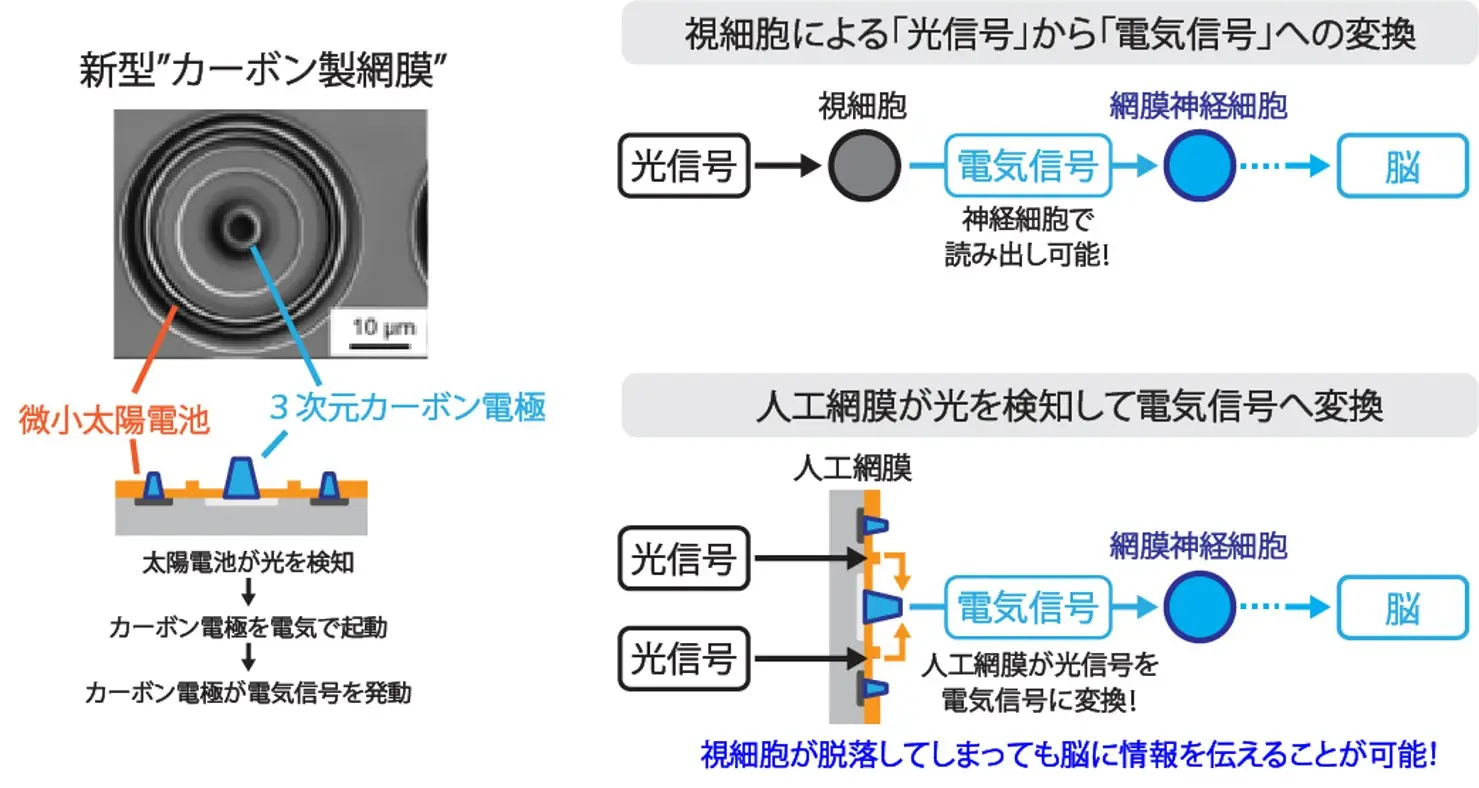
微小太陽電池と3次元カーボン電極で構成される光起電力型人工網膜
<関連情報>
- https://www.nig.ac.jp/highlights/15120/
- https://advanced.onlinelibrary.wiley.com/doi/10.1002/adhm.71651
高密度シリコン太陽電池アレイ上に集積された熱分解炭素マイクロ電極を用いたマウスおよびブタ網膜の光起電力刺激 Photovoltaic Stimulation of Mouse and Pig Retina With Pyrolytic Carbon Microelectrodes Integrated on High-Density Silicon Solar Cell Arrays
Akihiro Matsumoto, Pratik Kusumanchi, Jesper Guldsmed Madsen, Asbjørn Cortnum Jørgensen, Gisele Alves dos Reis Benatto, Sune Thorsteinsson, Peter Behrensdorff Poulsen, …
Advanced Healthcare Materials Published: 25 August 2026
DOI:https://doi.org/10.1002/adhm.71651
ABSTRACT
In this work, we introduce carbon as a novel electrode material in retinal prosthesis. We fabricate Si-based photovoltaic retinal implants with single p-n junctions in 40 µm and 200 µm pixels and successfully integrate pyrolytic carbon electrodes. Single pixels provide an open-circuit voltage of up to 0.5 V under near-infrared (NIR) illumination, demonstrating the functionality of the miniaturized solar cells despite the high thermal budget of the pyrolysis process. In electrophysiological ex vivo experiments with mouse retinal tissue, the intra- and extracellular spike activity significantly increased upon NIR-induced photovoltaic stimulation with the retinal implant compared to spontaneous activity, while spike amplitudes were comparable to the natural response to white light. The absence of action potentials after subsequent blocking of Na channels with tetrodotoxin confirmed the biological nature of the signals recorded during stimulation. Furthermore, spike amplitudes of evoked potentials were slightly higher for carbon electrodes compared to Au counterparts. Photovoltaic retinal implants with 3D carbon pillar electrodes were explored for ex vivo stimulation of porcine retinal tissue, confirming their ability to evoke action potentials in retinal neurons. The results demonstrate the potential of miniaturized photovoltaic pixels with 3D pyrolytic carbon electrodes.