
2026-09-09 フィンランド技術研究センター(VTT)
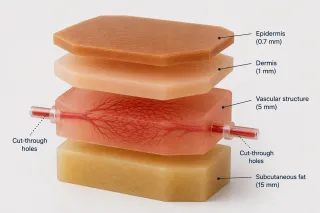
Schematic of the multi-layered skin-mimicking phantom developed at VTT. Image by Principal Scientist Alexey Popov, VTT, Flexible electronics and Human sensing.
<関連情報>
- https://www.vttresearch.com/en/news-and-ideas/artificial-skin-coffee-improve-wearables-different-skin-tones
- https://www.spiedigitallibrary.org/journals/journal-of-biomedical-optics/volume-31/issue-07/075001/Enhancing-skin-tone-representation-in-optical-vascular-phantoms/10.1117/1.JBO.31.7.075001.full
光学的血管ファントムにおける肌の色調表現の向上 Enhancing skin tone representation in optical vascular phantoms
Anni Ranta-Lassila, Lauri Rannaste, Jarno Petäjä, Marko Korkalainen, Markku Alamäki, Alexey Popov
Journal of Biomedical Optics Published:22 Jul 2026
DOI:https://doi.org/10.1117/1.JBO.31.7.075001
Abstract
Significance
Racial disparities and bias in the performance of optical medical devices, particularly in individuals with darker skin tones, have raised concerns about diagnostic accuracy and healthcare equity. To address the issue of misdiagnosis in people of color, there is a critical need for more representative tools in device testing and development. Skin-mimicking optical phantoms spanning a broad range of skin tones provide a practical solution, enabling more equitable and accurate evaluation of optical technologies.
Aim
We aimed to develop optical skin-mimicking phantoms representing a range of skin tones for use in the development and evaluation of optical medical and consumer wearable devices.
Approach
Multi-layered water-free silicone-based optical phantoms were designed and fabricated to replicate the optical and mechanical properties of the skin. A vascular structure was integrated into the phantoms, around which a micropump system was developed to simulate blood flow. The phantoms were evaluated using spectroscopy and hyperspectral imaging.
Results
The phantoms of varying skin tones with corresponding individual typology angle values spanning from 51.4 to −7.5 deg exhibited optical and mechanical properties comparable to real skin reflectance spectra across different pigmentation levels. Closer spectral agreement with skin was achieved using coffee compared with commercial pigment mixtures. The spectral signature of the blood-mimicking liquid was effectively masked by the darker superficial phantom layer mimicking heavily pigmented epidermis.
Conclusions
Optical skin-mimicking phantoms containing vascular structures with various skin tones were demonstrated, showcasing their potential as valuable and durable tools for improving the development of optical medical devices and consumer wearables for diverse populations.

