2026-09-17 東北大学
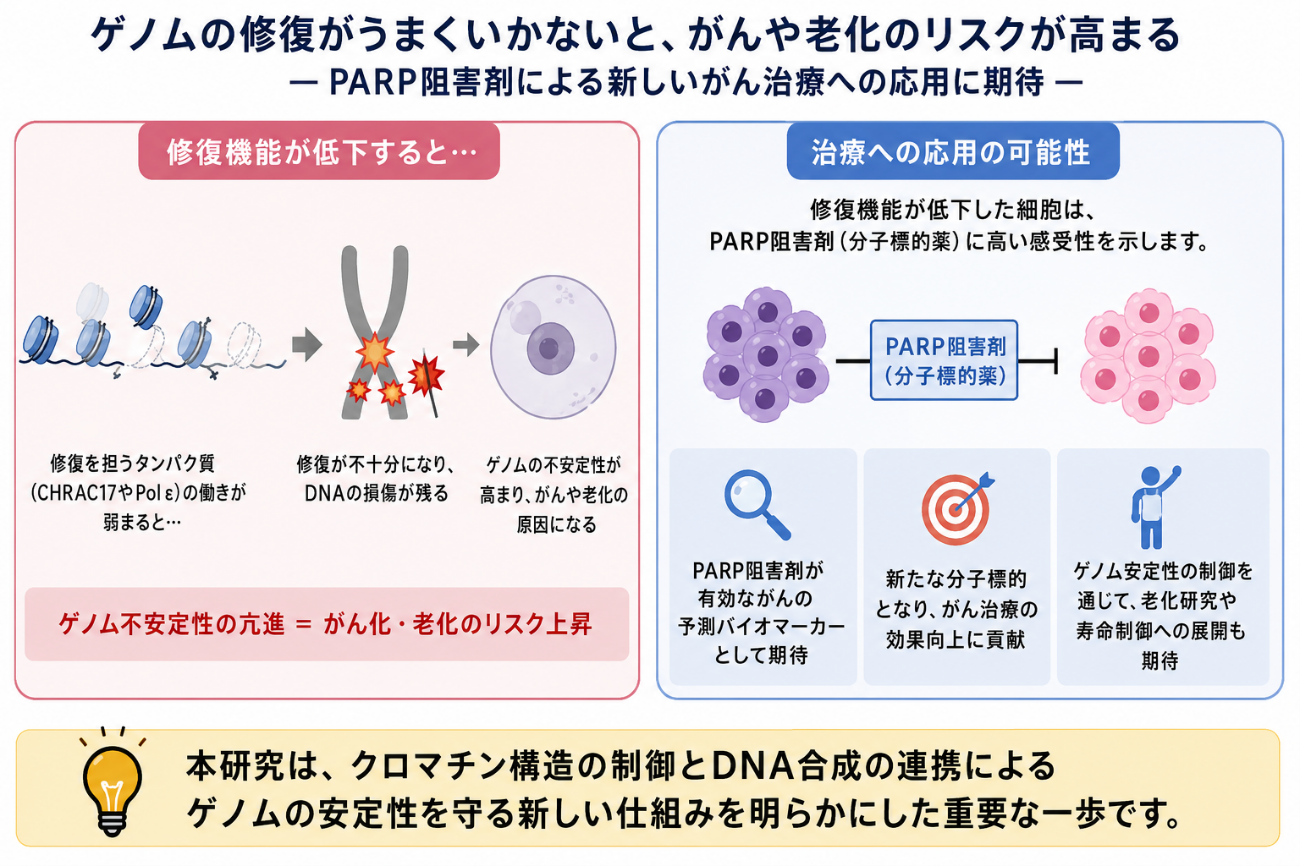
図1. 今回発見した新しいメカニズム
<関連情報>
- https://www.tohoku.ac.jp/japanese/2026/09/press20260917-02-chromatin.html
- https://www.nature.com/articles/s42003-026-10862-0
ISWI/CHRACは、相同組換えのためにDNAポリメラーゼεを動員することにより、連続的なクロマチンリモデリング活動を統制する ISWI/CHRAC orchestrates sequential chromatin-remodeling activities by mobilizing DNA polymerase ε for homologous recombination
Jianghao Qian,Kozo Tanaka,Akira Yasui & Ayako Ui
Communications Biology Published:15 September 2026
DOI:https://doi.org/10.1038/s42003-026-10862-0
Abstract
ATP-dependent chromatin remodeling is essential for replication, transcription, and DNA repair, especially DNA double-strand break (DSB) repair. However, the mechanisms underlying chromatin remodeling remain elusive. Here, we investigated the role of CHRAC17, a component of the chromatin assembly complex (CHRAC), in maintaining genome stability. In response to DSBs, the ISWI-family ATPase complex SNF2H-ACF1 is immediately recruited to DSBs through the H2B-type histone-fold protein CHRAC17, forming CHRAC, which promotes nucleosome assembly and recruits BRCA1 and RAD51 to the DSB site. CHRAC promotes later RAD51-mediated HR steps through additional nucleosome-remodeling activity, including nucleosome sliding activity. CHRAC17, also known as POLE3, is a subunit of DNA polymerase ε (Polε). Polε is recruited to DSBs via CHRAC17, facilitating RAD51-mediated homologous recombination (HR) and conferring resistance to PARP inhibitors. These findings define a mechanism of homologous recombination driven by coordinated regulation of nucleosome dynamics by CHRAC and Polε, thereby ensuring genome stability.