2026-09-17 東北大学
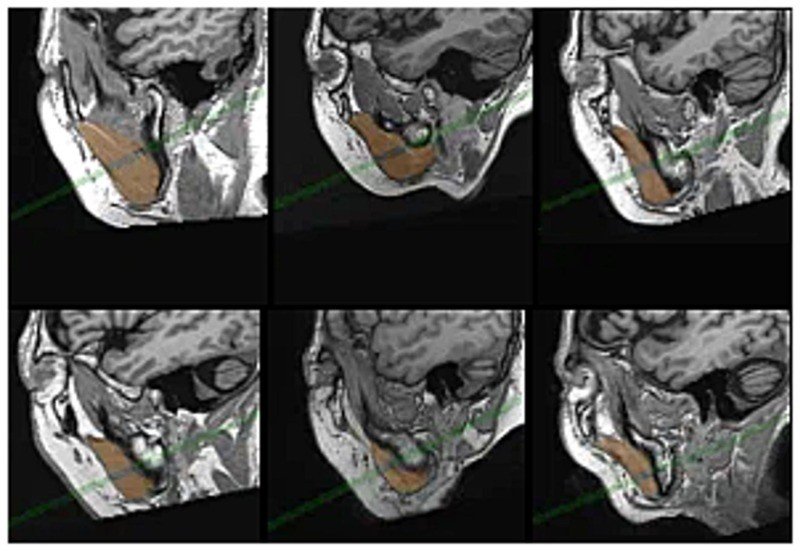
図1.AIによる咬筋の自動抽出例
頭部MRI画像上でAIが自動的に抽出した咬筋をオレンジ色で示している。
<関連情報>
- https://www.tohoku.ac.jp/japanese/2026/09/press20260917-01-masseter.html
- https://www.sciencedirect.com/science/article/pii/S0531556526002810
深層学習から得られた磁気共鳴画像法による咬筋容積は、高齢日本人における口腔機能障害および認知機能低下と関連している Deep learning-derived magnetic resonance imaging masseter muscle volume is associated with oral impairment and cognitive frailty in older Japanese adults
Liying Chen, Benjamin Thyreau, Yasuko Tatewaki, Yingxu Liu, Ken Takeda, Taizen Nakase, Shigeyuki Nakaji, Tatsuya Mikami, Yoshihiro Tamura, Wataru Kobayashi, Koichi Murashita, Toshiharu Ninomiya, Yasuyuki Taki
Experimental Gerontology Available online: 26 August 2026
DOI:https://doi.org/10.1016/j.exger.2026.113302
Highlights
- Automated quantification of masseter muscle volume from routine T1-weighted MRI
- Lower masseter volume associated with greater multidimensional oral impairment
- Masseter volume showed an inverse but attenuated association with cognitive frailty.
- CNN-derived masseter volume may be a scalable structural oral health marker.
Abstract
Background and objectives
The masseter muscle is associated with oral impairment and age-related functional decline, yet scalable and objective indicators remain limited in epidemiological studies. We developed a convolutional neural network (CNN) to segment the masseter muscle on T1-weighted magnetic resonance images (T1WI) and examined whether CNN-derived masseter muscle volume, as an imaging-based structural phenotype, is associated with oral impairment and cognitive frailty in older Japanese adults.
Methods
A CNN was developed using an iterative human-in-the-loop procedure based on T1WI acquired at Tohoku University Hospital. The trained model was then applied to available 3D T1WI from the Hirosaki site of the Japan Prospective Studies Collaboration for Aging and Dementia, and 2077 participants (mean age, 69.9 ± 4.1 years) were included in the final analyses after image quality control and application of the study exclusion criteria. Associations among masseter volume, oral impairment, and cognitive frailty were analyzed.
Results
Greater masseter volume was associated with a lower composite oral impairment score [odds ratio (OR) 0.67; 95% confidence interval: 0.60–0.74; p < 0.001]. Supplementary analyses showed the strongest association with structural abnormalities (OR 0.60), followed by periodontal inflammation (OR 0.81) and oral functional decline (OR 0.86). Masseter muscle volume showed an inverse association with cognitive frailty; however, this association was not significant after full adjustment. The pretrained CNN is available at https://github.com/bthyreau/masseter_mri.
Conclusions
CNN-derived masseter muscle parameters from magnetic resonance imaging were inversely correlated with oral impairment in older adults. This approach enables scalable and objective oral phenotyping from imaging data and highlights its potential application in large-scale epidemiological studies of aging and functional decline.