2026-09-17 東京大学
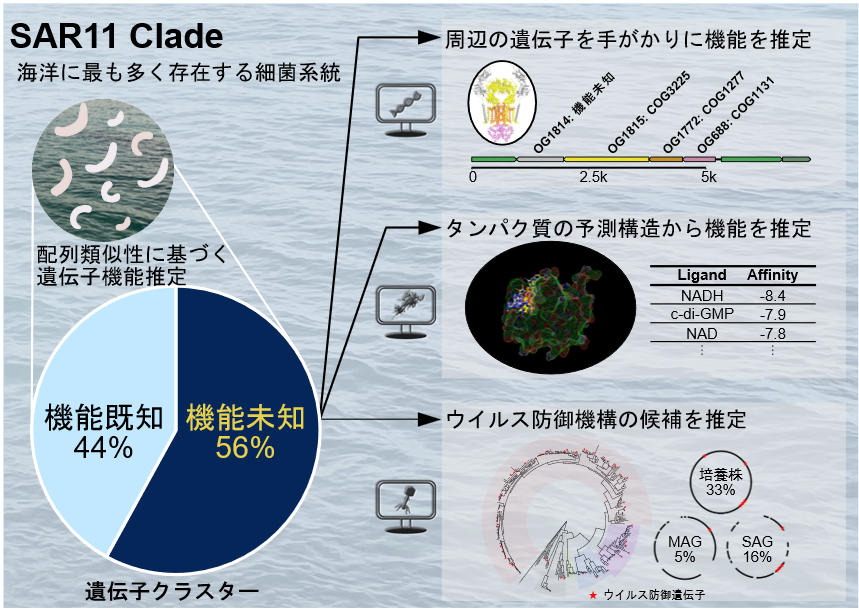
SAR11の機能未知遺伝子群の機能推定
<関連情報>
- https://www.k.u-tokyo.ac.jp/information/category/press/0030566.html
- https://journals.asm.org/doi/10.1128/msystems.01026-26
SAR11系統群の機能的非経済学は、ボトムアップおよびトップダウンの圧力への適応の根底にある隠れた遺伝的可能性を明らかにする Functional unknomics of the SAR11 clade reveal hidden genetic potential underlying adaptation to bottom-up and top-down pressures
Satoshi Nishino, Kento Tominaga, Kimiho Omae, Teppei Deguchi, Koji Hamasaki, Susumu Yoshizawa, Yuki Nishimura
mSystems Published:17 September 2026
DOI:https://doi.org/10.1128/msystems.01026-26
ABSTRACT
A substantial fraction of the genes in bacteria lack detectable sequence similarity to genes with known functions. These functionally uncharacterized genes—collectively referred to as the “unknome”—represent a largely unexplored genetic repertoire harboring insights into marine bacterial ecology. In this study, we explored the function of the unknome of the SAR11 clade, the most abundant bacterial lineage in the ocean, with a particular focus on genes that provide insight into its ecology. Based on the Clusters of Orthologous Genes and Kyoto Encyclopedia of Genes and Genomes classifications, approximately 56% of SAR11 ortholog groups were classified as members of the unknome. Among the SAR11 unknome, we successfully inferred the functions of 57 ortholog groups that are conserved in the SAR11 clade by protein structure similarity searches and genomic context analyses. These ortholog groups include putative transporter components, supporting the current ecological understanding that the SAR11 clade is specialized in substrate uptake to adapt to oligotrophic marine environments. Furthermore, structural analysis indicated that the DUF2237-containing protein, enriched in marine environments, may interact with purine nucleotide-containing compounds. This may suggest the existence of unique nucleotide utilization mechanisms in marine bacteria. In addition, we identified candidate viral defense systems within the unknome, indicating that diverse defense systems are present in at least one-third of cultured SAR11 strains. The presence of these defense systems, even within streamlined SAR11 genomes, suggests that they confer significant ecological advantages. Our analyses provide insights into the genetic basis of bottom-up processes (adaptation to oligotrophic environments) and top-down processes (antiviral defense strategy) contributing to ecological success.