2026-09-17 東京科学大学
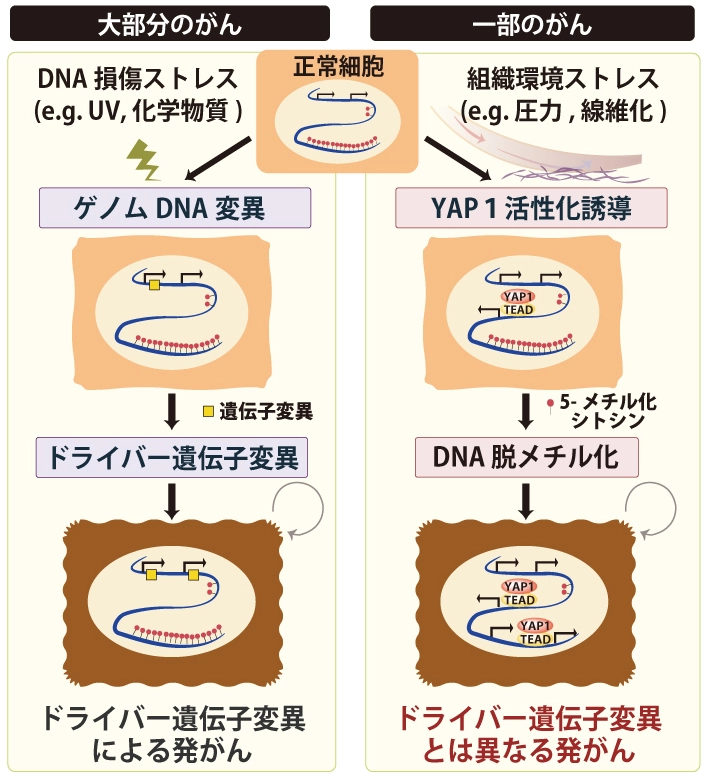
図1. 本研究の仮説
<関連情報>
YAP1は、典型的なドライバー遺伝子変異ではなく、DNA脱メチル化を介して肝細胞癌を誘発する YAP1 induces hepatocellular carcinoma via DNA demethylation rather than by canonical driver gene mutations
Misaki Kosaka, Yoshimi Okamoto-Uchida, Haruka Hirose, Yuya Nagaoka, Norio Miyamura, Akinori Kanai, Daiki Hatakeyama, Michiko Nakagawa, Miki Nishio, Tomohiko Maehama, Akira Suzuki, Yutaka Suzuki, Teppei Shimamura & Hiroshi Nishina
Communications Biology Published:17 September 2026
DOI:https://doi.org/10.1038/s42003-026-10882-w
Abstract
Large-scale genome sequencing analyses have identified driver gene mutations (DGMs) in most cancers as well as their associated tumorigenic mechanisms. However, a small fraction of cancers are not positive for these canonical DGMs, leaving the mechanisms underpinning their formation a mystery. We hypothesized that canonical DGM-negative cancers might be driven by activation of the transcriptional coactivator YAP1 that led to the induction of epigenetic changes. To test this theory, we established a mouse mosaic model of hepatocellular carcinoma (HCC) in which we induced YAP1-TEAD activation in a few hepatocytes. Whole-exome sequencing did not identify canonical DGMs in HCCs, but bisulfite sequencing revealed widespread DNA demethylation leading to the transcriptional activation of multiple oncogenes. Knockdown of the DNA demethylation-promoting gene, Tet1, attenuated HCC formation in these mice. Single-cell spatial transcriptomics identified a Tet1-high subpopulation of HCC cells that interacted with other hepatic cell types. Our mechanistic mouse data align with the observation that YAP1–TEAD–TET1-associated signatures were also elevated in hepatocytes from patients with Fontan-associated liver disease (FALD), a condition associated with the development of HCCs with lower frequencies of canonical DGMs. Our study suggests that the YAP1-TEAD-TET1 axis promotes canonical DGM-negative HCC development, and provides new insights into the molecular processes involved.