2026-09-24 マウントサイナイ医療システム(MSHS)
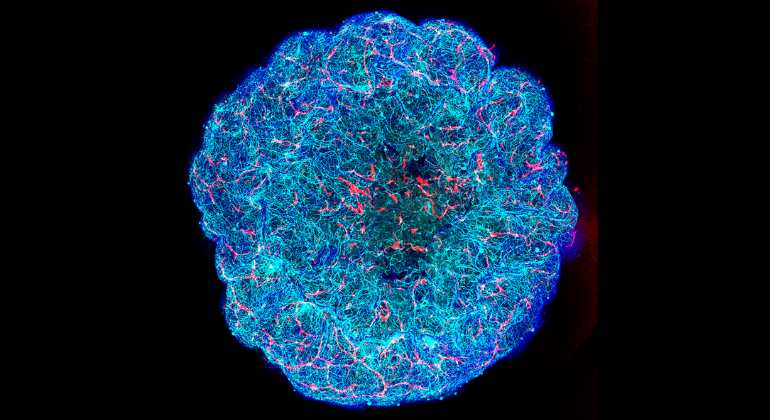
A laboratory-generated human miBrain, showing its complex, interconnected cellular and vascular architecture. Credit: Blanchard Lab/The Mount Sinai Health System
<関連情報>
- https://www.mountsinai.org/about/newsroom/2026/mount-sinai-researchers-identify-how-apoe4-gene-damages-brain-blood-vessels-in-alzheimers-disease
- https://www.cell.com/cell/fulltext/S0092-8674(26)01069-X
- https://www.cell.com/cell-stem-cell/fulltext/S1934-5909(26)00302-4
周皮細胞から筋線維芽細胞への移行がAPOE4と脳血管変性を結びつける A pericyte-to-myofibroblast transition links APOE4 to cerebrovascular degeneration
Braxton R. Schuldt ∙ Dominic Haworth-Staines ∙ Andrea Perez-Arevalo ∙ … ∙ Towfique Raj ∙ Ana C. Pereira ∙ Joel W. Blanchard
Cell Published:September 24, 2026
DOI:https://doi.org/10.1016/j.cell.2026.08.058
Highlights
- Single-nucleus analysis identifies an APOE4-enriched brain myofibroblast population
- APOE4 myofibroblasts emerge from pericytes
- APOE4 myofibroblasts drive cerebrovascular fibrosis and amyloid deposition
- TGF-β inhibition reverses the pericyte-to-myofibroblast transition
Summary
Cerebrovascular disease is a major but poorly understood feature of Alzheimer’s disease (AD). The strongest genetic AD risk factor, apolipoprotein E4 (APOE4), is associated with cerebrovascular degeneration, including vascular amyloid deposition and fibrosis. To uncover how APOE4 promotes cerebrovascular pathology, we assembled a single-cell transcriptomic atlas of human brain vasculature. In APOE4 carriers, pericyte abundance was significantly reduced and accompanied by the emergence of a myofibroblast-like cell population co-expressing contraction and extracellular matrix genes. Immunostaining confirmed non-vascular myofibroblasts in APOE4 human and mouse brains. We show that APOE4 pericytes transition into myofibroblasts that secrete fibronectin, which promotes vascular amyloid accumulation. Computational and experimental analyses identified elevated transforming growth factor β (TGF-β) signaling as the driver of this pericyte-to-myofibroblast transition. Inhibition of TGF-β restored pericyte coverage and reduced vascular fibrosis and amyloid to APOE3 levels, revealing a targetable mechanism linking APOE4 to cerebrovascular pathology in AD.
APOE4アストロサイトにおけるコレステロール調節異常はmiBrainにおけるα-シヌクレイン病理を促進する Cholesterol dysregulation in APOE4 astrocytes promotes α-synuclein pathology in miBrains
Louise A. Mesentier-Louro ∙ Camille Goldman ∙ Sebastian Gaese ∙ … ∙ Panos Roussos ∙ Vikram Khurana ∙ Joel W. Blanchard
Cell Stem Cell Published:August 24, 2026
DOI:https://doi.org/10.1016/j.stem.2026.08.001
Highlights
- A multicellular human brain model recapitulates α-synuclein pathological phenotypes
- APOE4 astrocytes alone are sufficient to drive neuronal α-synuclein pathology
- APOE4 cholesterol dysregulation impairs astrocytic processing of α-synuclein
- Cholesterol modulation reduces pathological phenotypes in APOE4 miBrains
Summary
The pathological hallmarks of neurodegeneration are the aberrant post-translational modification and aggregation of proteins. Genetic factors, like APOE4, increase the prevalence and severity of tau, amyloid, and α-synuclein pathologies. However, the human brain is largely inaccessible during this process, limiting mechanistic understanding. Here, we developed an iPSC-based 3D model that integrates neurons, glia, myelin, and cerebrovascular cells into a human brain-like tissue (“miBrain”). Single-nucleus RNA sequencing of miBrains confirmed the presence of diverse cell populations and revealed transcriptional responses to α-synuclein pathology. Like the human brain, pathogenic α-synuclein is increased in APOE4/4 miBrains. Combinatorial experiments revealed that endolysosomal dysfunction caused by cholesterol accumulation in APOE4/4 astrocytes impairs the degradation of soluble α-synuclein leading to a pathogenic transformation that seeds α-synuclein inclusions in neurons. Collectively, this study establishes a robust model for investigating protein inclusions in human iPSC-derived brain tissue and highlights the role of astrocytes and cholesterol in APOE4-mediated pathologies.