2026-09-24 ウィスコンシン大学マディソン校(UW-Madison)
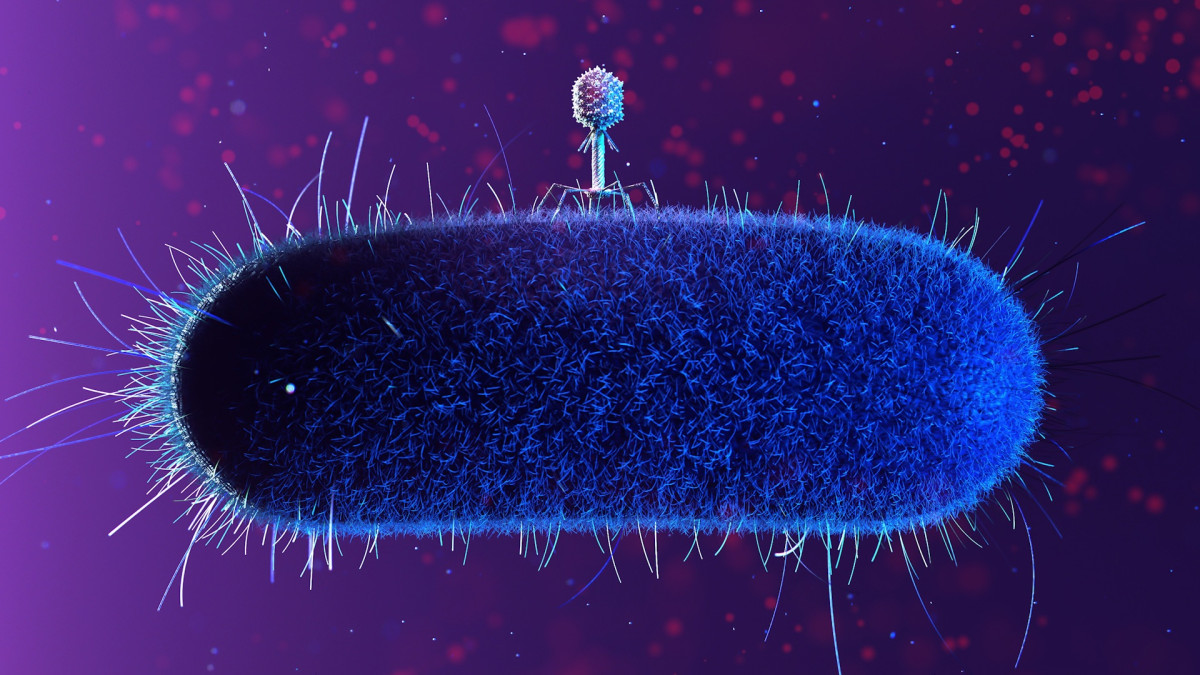
One promising approach to targeting unwanted bacteria is phage therapy, which uses naturally occurring and engineered viruses known as phages (illustrated above, resting on the surface of a host cell) to infect and destroy specific bacteria. Courtesy of the Raman Lab
<関連情報>
- https://news.wisc.edu/enlisting-ai-in-the-fight-against-drug-resistant-bacteria/
- https://www.science.org/doi/10.1126/sciadv.aed3641
- https://www.cell.com/cell-systems/abstract/S2405-4712(26)00194-8
カプセル分解ファージの尾部スパイクタンパク質における構造的制約と適応可能性のマッピング Mapping structural constraints and adaptive potential in a capsule-degrading phage tailspike protein
Sarah Evert, Phil Huss, Dinesh Kumar Kuppa Baskaran, Karthik Anantharaman, and Srivatsan Raman
Science Advances Published:11 Sep 2026
DOI:https://doi.org/10.1126/sciadv.aed3641
Abstract
Bacteriophage tailspike proteins (TSPs) degrade bacterial capsules to enable infection, yet the molecular determinants of their function and host range remain unclear. We applied deep mutational scanning (DMS) to the endosialidase TSP of Escherichia coli K1 phage K1F, generating 22,365 single–amino acid variants using an enhanced ORACLE phage engineering platform. Functional scores revealed that the TSP is structurally fragile yet harbors pockets of adaptive flexibility. Mutations within the β-propeller active site uncovered residues accommodating longer sialic acid chains than captured by structural studies, while the β helix stalk emerged as an adaptive “tuning knob” modulating processivity and specificity. Comparative selections across K1 strains identified discrimination hotspots in β barrel loops and distal residues outside canonical binding sites, implicating capsule modifications and O-antigen presence as key modulators of host range. By resolving how specific mutations modulate function and host range, this study offers a roadmap for designing phages that overcome capsule-based defenses in pathogenic bacteria.
バクテリオファージ特異性の多目的学習と設計 Multiobjective learning and design of bacteriophage specificity
Naia Novy ∙ Phil Huss ∙ Sarah Evert ∙ Philip A. Romero ∙ Srivatsan Raman
Cell Systems Published:September 1, 2026
DOI:https://doi.org/10.1016/j.cels.2026.101712
Highlights
- Deep learning designs T7 bacteriophages for 26 multiobjective host-targeting tasks
- CNNs match fine-tuned protein language models when trained on large phage datasets
- T7 host-targeting is highly plastic: opposite specificities differ by a few mutations
- Framework achieves success rates that enable low-throughput validation of phage designs
Summary
Proteins are often optimized for single functions during design and engineering without the consideration of other functionalities that may interfere with the intended outcome. Here, we apply deep learning to understand and design the multifunctional host-targeting landscape of the T7 bacteriophage receptor-binding protein for enhanced infectivity, predefined specificity, and high generality toward unseen strains. We compare four model architectures and experimentally characterize engineered phages optimized for 26 tasks. With multiobjective machine learning, it is possible to engineer complex specificities at success rates that enable low-throughput validation of predicted hits. The targeting capabilities of T7 are highly plastic, with opposite specificities occasionally separated by only a few mutations. This tunability underscores how models trained on multifunctional data can uncover key principles of phage biology and specificity. The same framework can guide multiobjective optimization of other proteins or biological systems, offering a general strategy for modeling multifunctional landscapes.