2026-09-08 スタンフォード大学
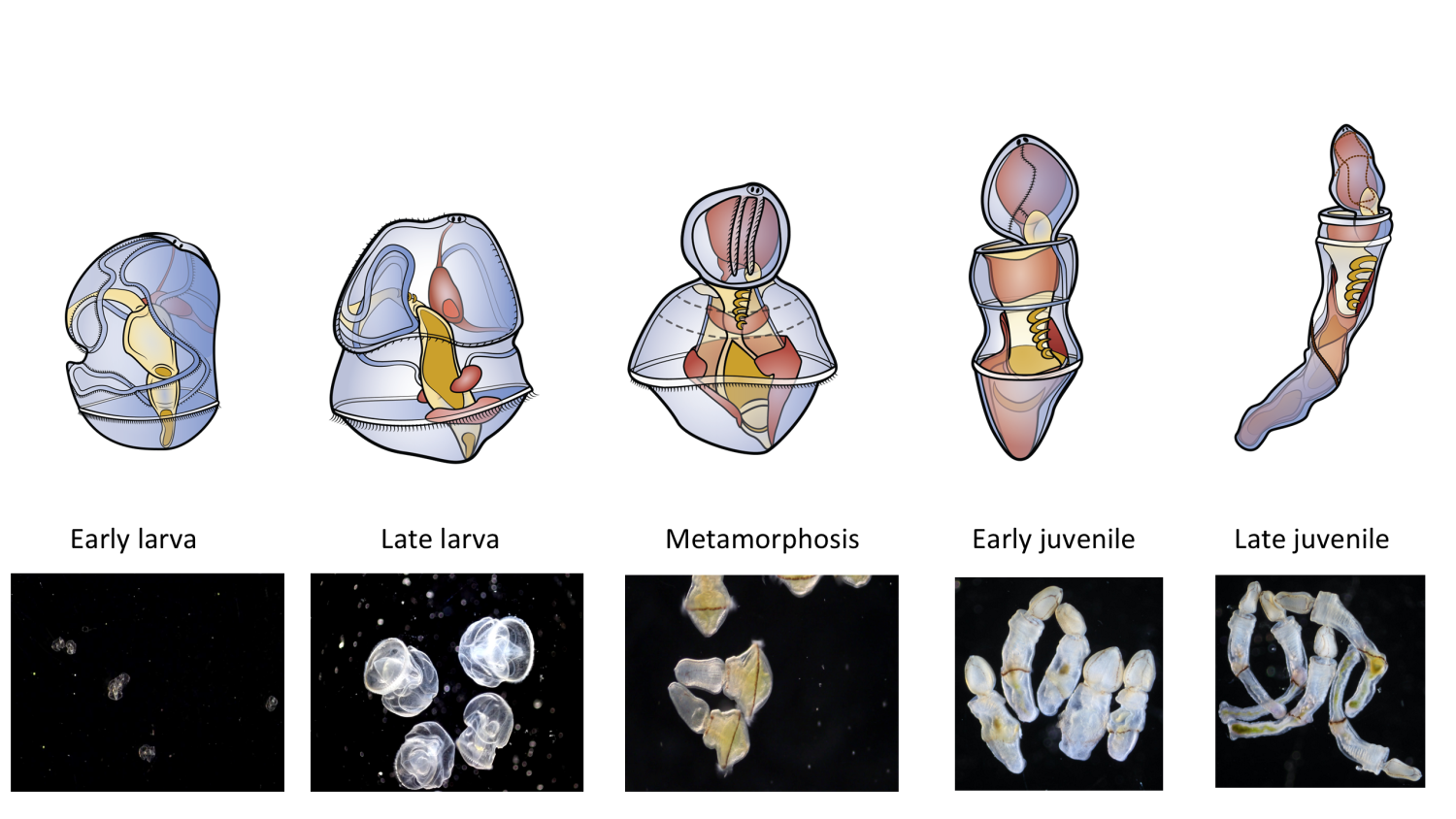
As the acorn worm Schizocardium californicum grows, it undergoes a radical physical transformation that completely changes its body shape. Illustrations by Sami Chang. | Paul Bump
<関連情報>
- https://news.stanford.edu/stories/2026/09/acorn-worms-cellular-reprogramming
- https://www.nature.com/articles/s41467-026-77191-y.
半索動物では、異なる細胞状態によって幼生と成体の体構造が規定される Distinct cell states define larval and adult body plans in a hemichordate
Paul Bump,Carolyn Brewster,Laurent Formery,Lauren Lubeck,Catherine Campbell,Maurizio Morri,Rene Sit,Daniel S. Rokhsar,Blair Benham-Pyle,Alejandro Sánchez Alvarado & Christopher J. Lowe
Nature Communications Published:08 September 2026
DOI:https://doi.org/10.1038/s41467-026-77191-y
Abstract
A major gap in our understanding of animal development is how adult body plans arise in animals with indirect development, where adults emerge from the transformation of a distinct larval form during metamorphosis. We address this question by examining cellular changes in the enteropneust hemichordate Schizocardium californicum, a species with a complex lifecycle and dramatic metamorphosis. Employing whole-body single-cell RNA sequencing, we chart the cellular composition and transcriptional dynamics of larval, metamorphic, and adult stages. Our tissue-level atlas reveals that ectodermal and endodermal cell types in larvae and adults occupy distinct transcriptional spaces, showing greater similarity to other cell types within the same life stage than to their counterparts in the opposite stage. In contrast, mesodermal cell types from both larvae and adults cluster closely together, indicating conserved transcriptional profiles. These findings demonstrate that the extensive morphological reorganization during metamorphosis is accompanied by broad shifts in transcriptional identity and reveal life-history stage as a major organizing axis of cellular state during the larva-to-adult transition.