
2026-09-28 ワシントン大学(UW)
<関連情報>
- https://www.washington.edu/news/2026/09/28/september-research-highlights-multitasking-microbes-ancient-capybaras-the-law-of-the-land-more/
- https://academic.oup.com/ismej/advance-article/doi/10.1093/ismejo/wrag234/8790524
北太平洋の原生生物群集における光合成と呼吸のバランス Balancing photosynthesis and respiration in North Pacific protist communities
Sacha N Coesel, Shiri Graff van Creveld, Mathilde Dugenne, Bryndan P Durham, Michael J Follows, Rebecca S Key, Francois Ribalet, Angelicque E White, E Virginia Armbrust
The ISME Journal Published:11 September 2026
DOI:https://doi.org/10.1093/ismejo/wrag234
Abstract
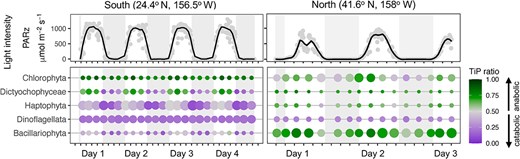
Marine plankton fuel their metabolism through a continuum of trophic strategies, spanning from pure autotrophy to pure heterotrophy, with mixotrophy combining the two modes within a single organism. Different taxa balance these strategies depending on environmental conditions, complicating efforts to link community composition with ecosystem processes. To quantify the transcriptional investment in processes supporting primary production versus respiration along the trophic continuum, we developed the Transcript-informed Productivity (TiP) metric, defined as the ratio of transcripts in photosynthesis-related pathways (e.g., photosynthesis, carbon fixation) to those in both photosynthesis and respiration-related pathways (e.g., respiration, macromolecule degradation). Higher TiP indicates greater transcriptional investment in primary productivity, whereas lower TiP reflects reduced investment in primary productivity and/or increased investment in catabolic activities. We applied TiP across eukaryotic plankton size classes (~1-100 μm) and taxonomic groups using metatranscriptomes collected during three latitudinal expeditions across the North Pacific. By combining TiP with 18S rRNA gene sequence data and cell size characterization via flow cytometry, we show that biomass in more nutrient-rich areas was dominated by larger phototrophic eukaryotic plankton (diatoms) with higher TiP, consistent with elevated net community productivity. In nutrient-limited areas, eukaryotic pico- and nano-phytoplankton were dominated by Haptophyta and Dinophyta and displayed reduced TiP, suggesting greater reliance on energy from respiration rather than photosynthesis, consistent with mixotrophic strategies supporting these taxa under nutrient limitation. The TiP metric provided taxon-resolved indicators of eukaryotic productivity and respiration and can complement bulk Net Community Productivity (NCP) measurements by identifying the taxa contributing most to ecosystem metabolic balance.

