
2026-09-28 マサチューセッツ工科大学(MIT)
<関連情報>
- https://news.mit.edu/2026/new-formulation-helps-rna-vaccines-withstand-high-temperatures-0928
- https://www.nature.com/articles/s41587-026-03331-w
データ効率の高いAIを用いた耐熱性mRNA-脂質ナノ粒子ワクチンの迅速な発見 Accelerated discovery of thermostable mRNA–lipid nanoparticle vaccines using data-efficient AI
Jinbi Tian, Khanh T. M. Tran, Brett H. Pogostin, Olivia Sheridan, Sevinj Mursalova, Amy H. Lee, Shuai Liu, Jaya Hamkins, Daniel Antov, Alana L. Power, Zane S. Dash, Dongsoo Yun, Mina Konaković Luković, Robert S. Langer & Ana Jaklenec
Nature Biotechnology Published:28 September 2026
DOI:https://doi.org/10.1038/s41587-026-03331-w
Abstract
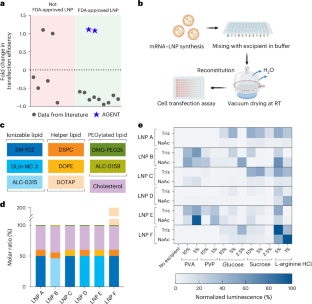
The instability of mRNA−lipid nanoparticles (LNPs) necessitates ultra-cold storage, limiting global distribution and their broader application in advanced delivery systems. Solid-state, water-free formulations enhance thermostability and enable integration into emerging delivery modalities such as microneedle patches. Previous efforts to stabilize mRNA−LNPs have been constrained by narrow formulation scope and low-throughput screening methods. Here we introduce Algorithm-Guided Experimental design for lipid Nanoparticle Thermostabilization (AGENT), an artificial intelligence (AI)-driven framework that couples high-throughput experimentation with Bayesian optimization to identify thermostable mRNA−LNP formulations. AGENT extracts maximal information from sparse experimental datasets, enabling efficient formulation optimization in six iterations completed within 1 month. We stabilized mRNA vaccines with two clinically relevant LNPs representative of the Moderna (SM-102-based) and Pfizer-BioNTech (ALC-0315-based) compositions into solid-state formulations that retained 100% bioactivity after storage at 37 °C for more than 2 months. In rodents and non-human primates, thermostable, solid-state vaccine formulations induced antigen-specific immune responses non-inferior to those elicited by intramuscular delivery of freshly prepared soluble vaccines.

