2026-10-05 シカゴ大学(UChicago)
<関連情報>
- https://news.uchicago.edu/story/does-birth-order-shape-our-health-uchicago-scientists-analyze-5-million-families-understand
- https://www.nature.com/articles/s44360-026-00177-z
出生順位とヒト表現型全体における疾患リスク Birth order and disease risk across the human phenome
Benjamin Kramer, Steven A. Kushner & Andrey Rzhetsky
Nature Health Published:03 August 2026
DOI:https://doi.org/10.1038/s44360-026-00177-z
Abstract
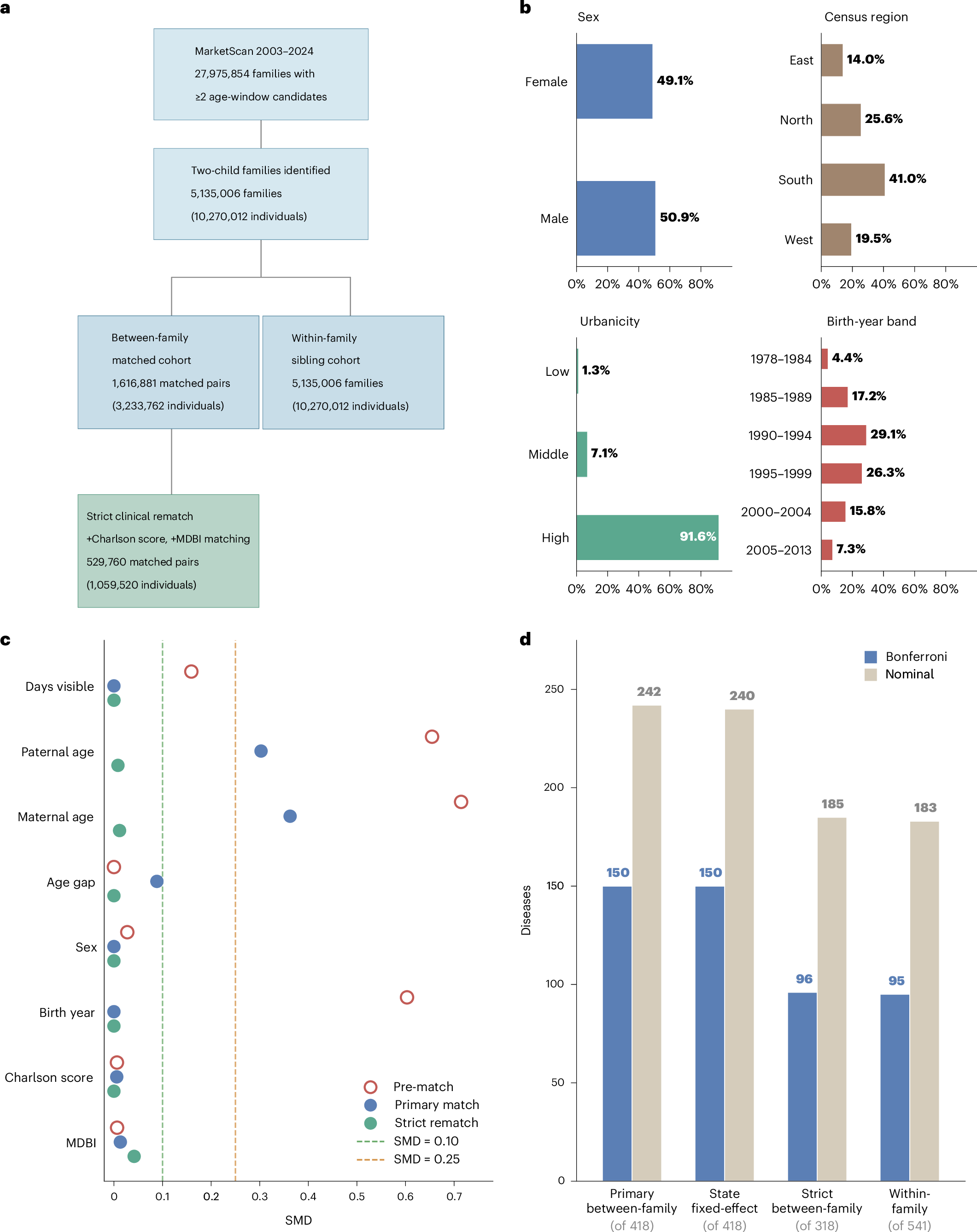
Birth-order effects on disease risk have been studied for individual conditions but have not been systematically assessed at phenome-wide scale in large sibling claims cohorts. We apply two complementary designs, a between-family matched cohort (1.6 million pairs) as a high-powered phenome-wide scan, and a within-family sibling comparison (5.1 million families) as an internally controlled sibling contrast, to 569 diseases in Merative MarketScan claims data. Of 418 diseases with adequate case counts, 150 show Bonferroni-significant associations. First-borns carry excess risk for neurodevelopmental conditions (other/unspecified pervasive-developmental-disorder (PDD) code group odds ratio (OR) = 0.57, autism OR = 0.74, attention-deficit/hyperactivity disorder OR = 0.93) and immune-allergic diseases (food allergy OR = 0.80, allergic rhinitis OR = 0.91); second-borns for substance abuse (OR = 1.19) and gastrointestinal conditions (gastritis/duodenitis OR = 1.14). Across diseases analyzed in both designs, between-family and within-family estimates were positively correlated (r = 0.66; 74.2% directionally concordant); 84.7% of Bonferroni-significant between-family hits agreed in direction. Results are robust to state fixed effects (r > 0.99), full-sibling restriction and stricter clinical rematching (r = 0.93). These findings provide a comprehensive map of birth-order effects in the human disease phenome.