2026-10-14 ロックフェラー大学
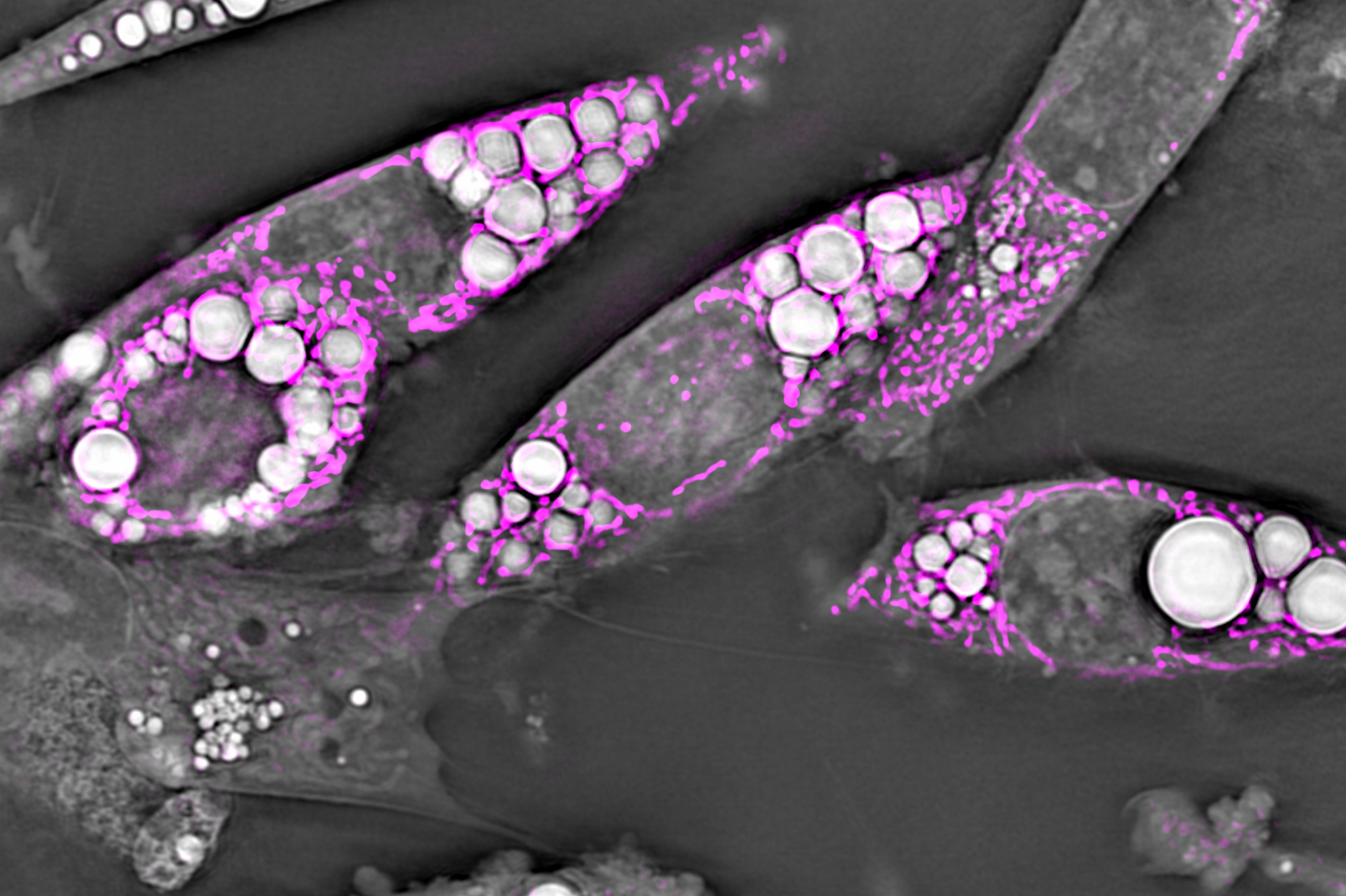
Brown fat cells with mitochondria labeled in magenta. (Image acquired on a CSR Biotech Cell Xtreme microscope on demo at the BIRC)
<関連情報>
- https://www.rockefeller.edu/news/40712-brown-fat-metabolism-losartan-heart-disease-diabetes/
- https://www.nature.com/articles/s41586-026-11162-7
- https://www.nature.com/articles/s41591-020-1126-7
人工知能を活用したヒト褐色脂肪の臨床表現型解析 Artificial intelligence-enabled clinical phenotyping of human brown fat
Nicolás Gómez-Banoy, Jorge A. Barrero, Luiza Rachel Pinheiro de Carvalho, Caroline S. Jiang, Tara Doma Lama, Nakul Karandikar, Mascha Koenen, Tiffany Lam, Kaja Plucińska, Ksenia Morozova, Stephanie Chahwan, Gustavo Barraza, Burcin Agridag Ucpinar, Jennifer E. Liu, Rohit Sharma, Daniel Lafontaine, Heiko Schöder & Paul Cohen
Nature Published:14 October 2026
DOI:https://doi.org/10.1038/s41586-026-11162-7
Abstract
Adipose tissue has a central role in systemic energy balance and the pathogenesis of obesity and its sequelae1,2. In contrast to white adipose tissue, brown adipose tissue (BAT) uses energy to produce heat3. Detectable BAT in humans is associated with decreased prevalence of cardiometabolic diseases4. However, the complete spectrum of health conditions associated with BAT remains unknown, and high-throughput methods to quantify BAT activity in humans are lacking5,6. Here we leveraged big data and artificial intelligence to systematically define the clinical impact of BAT in a cohort of 101,243 patients from a large cancer centre. Our unbiased analyses revealed that, across all diagnoses, cardiovascular and psychiatric diseases were less prevalent in people with BAT. Using a machine learning approach, we semi-automatically quantified BAT activity in approximately 8,700 patients and demonstrated that higher BAT activity, especially in the axillary depot, is associated with lower odds of cardiometabolic diseases and healthier white fat distribution. People with BAT also exhibited more favourable glycaemic parameters, lipid profiles, inflammatory markers and echocardiographic indices. Analysis of medication usage demonstrated that angiotensin receptor blocker use was positively associated with BAT presence. As proof of concept, we showed that the angiotensin receptor blocker losartan increased brown adipocyte activity and whole-body energy expenditure. Altogether, our studies harnessing artificial intelligence and big data identify new clinical phenotypes linked to BAT and serve as a platform for drug repurposing to activate this tissue in humans.
褐色脂肪組織は心血管代謝の健康状態と関連している Brown adipose tissue is associated with cardiometabolic health
Tobias Becher, Srikanth Palanisamy, Daniel J. Kramer, Mahmoud Eljalby, Sarah J. Marx, Andreas G. Wibmer, Scott D. Butler, Caroline S. Jiang, Roger Vaughan, Heiko Schöder, Allyn Mark & Paul Cohen
Nature Medicine Published:04 January 2021
DOI:https://doi.org/10.1038/s41591-020-1126-7
Abstract
White fat stores excess energy, whereas brown and beige fat are thermogenic and dissipate energy as heat. Thermogenic adipose tissues markedly improve glucose and lipid homeostasis in mouse models, although the extent to which brown adipose tissue (BAT) influences metabolic and cardiovascular disease in humans is unclear1,2. Here we retrospectively categorized 134,529 18F-fluorodeoxyglucose positron emission tomography–computed tomography scans from 52,487 patients, by presence or absence of BAT, and used propensity score matching to assemble a study cohort. Scans in the study population were initially conducted for indications related to cancer diagnosis, treatment or surveillance, without previous stimulation. We report that individuals with BAT had lower prevalences of cardiometabolic diseases, and the presence of BAT was independently correlated with lower odds of type 2 diabetes, dyslipidemia, coronary artery disease, cerebrovascular disease, congestive heart failure and hypertension. These findings were supported by improved blood glucose, triglyceride and high-density lipoprotein values. The beneficial effects of BAT were more pronounced in individuals with overweight or obesity, indicating that BAT might play a role in mitigating the deleterious effects of obesity. Taken together, our findings highlight a potential role for BAT in promoting cardiometabolic health.