2026-10-19 ノースウェスタン大学
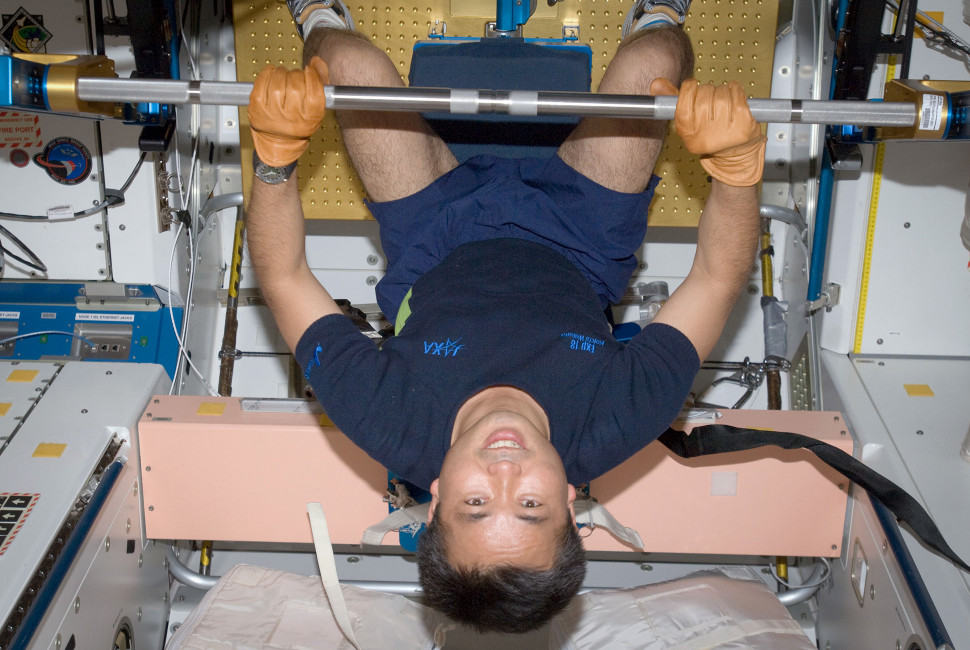
Following a NASA program called Exercise Countermeasures, the astronauts in the study worked out for up to two hours a day, including 30 to 45 minutes of endurance exercise and 60 to 75 minutes of resistance training. Pictured Japan Aerospace Exploration Agency astronaut Koichi Wakata exercises using the advanced Resistive Exercise Device in the Unity node of the International Space Station. Image by NASA
<関連情報>
- https://news.northwestern.edu/stories/2026/10/exercise-helps-astronauts-hearts-handle-months-in-space-boosting-prospects-for-mars
- https://www.ahajournals.org/doi/10.1161/CIRCULATIONAHA.125.078665
長期宇宙飛行が心臓の構造と機能に及ぼす影響:探索的縦断観察研究 Impact of Prolonged Spaceflight on Cardiac Structure and Function: An Exploratory Longitudinal Observational Study
Vinesh Appadurai, MBBS, Kazuaki Negishi, MD, PhD, MSc, Allen G. Borowski, RDCS, Zoran B. Popović, MD, PhD, Neil L. Greenberg, PhD, David S. Martin, MS, RDCS, Michael W. Bungo, MD, Benjamin D. Levine, MD, and James D. Thomas, MD
Circulation Published: 15 September 2026
DOI:https://doi.org/10.1161/CIRCULATIONAHA.125.078665
Abstract
BACKGROUND:
Gravitational gradients, ranging from the surface of the Earth (1 G) to the microgravity of spaceflight (0 G), including intermediate gravitational fields such as those on Mars (⅜ G), directly affect cardiovascular hemodynamics. We sought to track changes in cardiac structure and function over the course of long-duration spaceflight and compare them with responses to specific gravitational loads measured preflight and postflight in a uniquely simulated Martian gravitational load.
METHODS:
We performed a prospective, within-subject, repeated-measures observational study of astronauts during flights to the International Space Station, with acquisition of echocardiographic variables during preflight supine rest and upright tilt at specific gravitational loads, including simulated Martian gravity (22° tilt; 0.38 G). Data were subsequently acquired during spaceflight onboard the International Space Station, upon landing on Earth, and after landing during exposure to simulated Martian gravity. Offline analyses of echocardiographic images were performed according to standardized methods, including myocardial deformation measurements.
RESULTS:
Thirteen astronauts (9 male) with a mean age of 49±4 years were included. The median spaceflight duration was 164 days (interquartile range, 126 to 169 days; median absolute deviation, 21 days). Significant reductions occurred in left ventricular (LV) end-diastolic volume, stroke volume, and myocardial deformation measures from preflight supine to early in-flight (14 days) measures in microgravity. These early in-flight values were similar in magnitude to those observed in the preflight upright Earth posture, with the exception of an increase in LV longitudinal strain magnitude (−14.5%±1.79% versus −16.9%±2.03%; P=0.006) and a reduction in LV global circumferential strain (−26.09%±1.76% versus −23.3%±3.22%; P=0.016). Throughout the subsequent duration of spaceflight, LV end-diastolic volume and LV stroke volume increased toward preflight supine values. After ≈6 months in space, when astronauts were exposed to simulated Martian gravity (⅜ G), no volumetric or hemodynamic measure evinced greater load or hemodynamic stress than upright posture on Earth before flight.
CONCLUSIONS:
In this small exploratory study, initial changes in LV chamber volumes, myocardial mechanics, cardiac output, and stroke volume with transition from Earth’s gravitational loads to microgravity were transient and stabilized during flight. Given current countermeasures, prolonged spaceflight of up to 6 months does not result in large changes in cardiac structure or function within the context of normal posture variations on Earth. These adaptations generally return to baseline upon return to Earth, with no large changes in cardiac volumes or function relative to the upright posture on Earth in a simulated Martian gravity landing, suggesting that orthostatic intolerance may be unlikely to occur on Mars after a 6-month transport with appropriate exercise countermeasures.