2026-10-21 東北大学
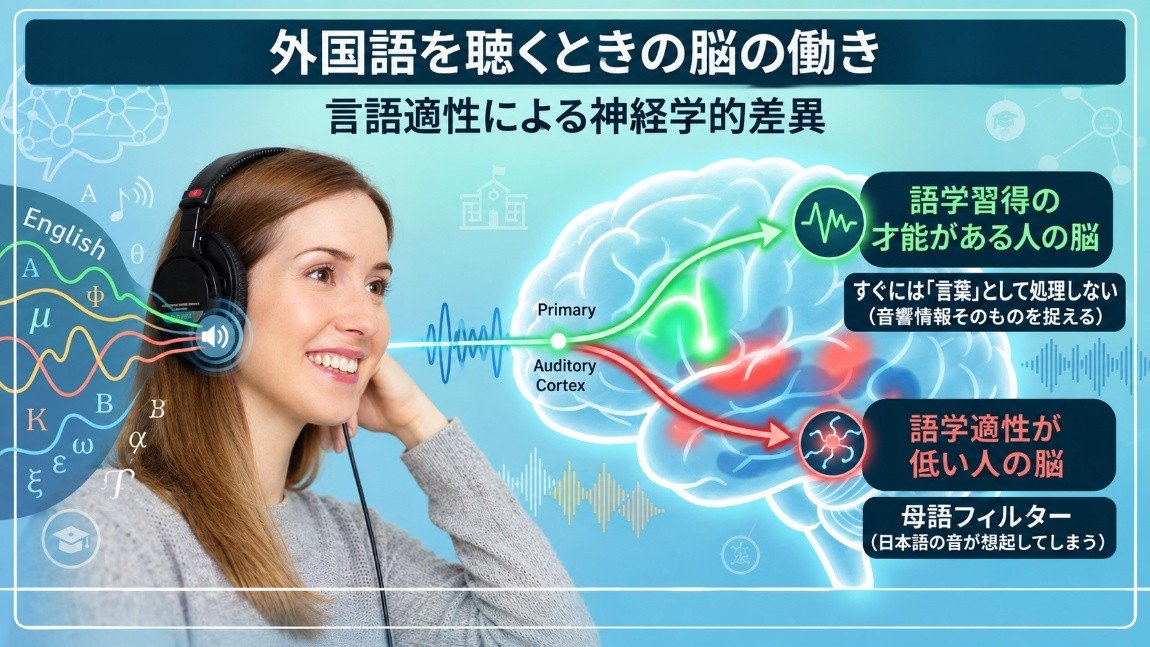
図1.外国語を聞くときの脳の働き(イメージ図)
<関連情報>
- https://www.tohoku.ac.jp/japanese/2026/10/press20261021-01-auditory.html
- https://psycnet.apa.org/fulltext/2028-38117-002.html
第二言語音声学習における運動および聴覚活性化の個人差:領域横断的な聴覚処理の役割 Individual Differences in Motor and Auditory Activation in Second Language Speech Learning: Roles of Domain-General Auditory Processing
Kazuya Saito-van Poeteren, Adam Tierney, Kotaro Takizawa, Diego Elisandro Dardon, Chunlin Liu, Magdalena Kachlicka, Motoaki Sugiura, Hyeonjeong Jeong
Journal of Experimental Psychology: General Accepted: July 5, 2026
DOI:https://doi.org/10.1037/xge0001991
Abstract
While existing models emphasize the critical roles of auditory and motor systems in speech perception, it remains unclear how individual learners differentially rely on these systems and how their relative weighting relates to language learning. This study investigates the neural mechanisms through which individual differences in domain-general auditory processing influence reliance on these networks during second language (L2) phonetic learning. Focusing on the acquisition of English [æ] and [ʌ] by 207 Japanese learners, we examined participants with varying auditory precision profiles using both behavioral and functional magnetic resonance imaging analyses as they performed discrimination tasks for speech and nonverbal sounds. The findings revealed a pattern consistent with a triangular relationship among learners’ auditory precision, brain activation in motor-related regions, and L2 speech development. Learners with lower auditory precision tended to show less advanced L2 vowel proficiency and exhibited higher levels of sensorimotor activation during discrimination of English [æ] and [ʌ], but not during discrimination of nonspeech counterparts with comparable second formant variation. In light of theoretical accounts of adult L2 speech learning (Best & Tyler, 2007), one possible interpretation is that greater reliance on articulatory processing among less auditory-precise and less experienced or proficient L2 learners reflects the processing of L2 sounds through first language articulatory routines. In contrast, learners with higher auditory precision attained not only more advanced L2 vowel proficiency but also lower levels of sensorimotor activity, comparable to that observed during nonverbal processing, suggesting more balanced spectrotemporal and articulatory analyses of sounds, which optimize both the process and outcomes of L2 speech learning.