2026-11-04 国立精神・神経医療研究センター
<関連情報>
- https://www.ncnp.go.jp/topics/detail.php?@uid=3mU9GiVp4HjpJYdU
- https://onlinelibrary.wiley.com/doi/10.1002/glia.70251
出生後の小脳発達におけるベルクマン神経膠様前駆細胞の系統分化の進行 Progressive Lineage Restriction of Bergmann Glia-Like Progenitors During Postnatal Cerebellar Development
Toma Adachi, Kyoka Suyama, Sotaro Ito, Eriko Isogai, Masaki Sone, Mikio Hoshino
Glia Published: 04 November 2026
DOI:https://doi.org/10.1002/glia.70251
Abstract
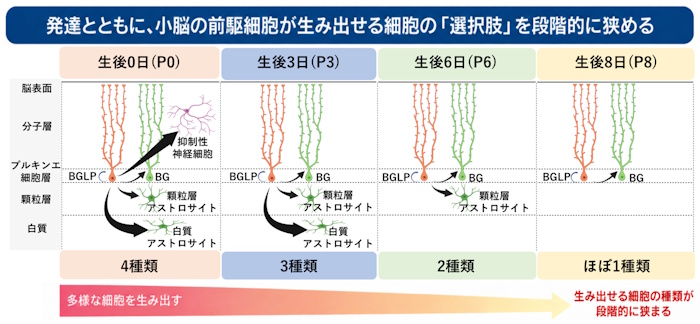
Bergmann glia-like progenitors (BGLPs) are transient progenitors in the postnatal cerebellum, but how their lineage potential changes during development remains incompletely understood. Our previous electroporation-based study suggested that P0 BGLPs possess broader lineage potential than P6 BGLPs. Here, we performed recombination-based lineage tracing by cerebellar surface application of tamoxifen to Ai9/+; GlastCreERT2/+ mice and temporally analyzed the progeny of BGLPs labeled at P0, P3, P6, and P8. We found that BGLPs undergo progressive lineage restriction during postnatal development. P0 BGLPs gave rise to Bergmann glial cells (BGs), inner granule cell layer astrocytes (IGL astrocytes), white matter astrocytes (WM astrocytes), and molecular layer inhibitory neurons (ML-INs), confirming our previous electroporation-based findings. In contrast, P3 BGLPs generated BGs, IGL astrocytes, and WM astrocytes, whereas P6 BGLPs generated BGs and IGL astrocytes, and P8 BGLPs generated predominantly BGs. Thus, BGLP lineage output was progressively restricted from four progeny categories at P0 to a predominantly BG-restricted output by P8, suggesting that BGLPs dynamically adjust their cellular output during postnatal cerebellar maturation. Additional temporal analyses were consistent with a stepwise pathway from P0 BGLPs to ML-INs, in which astrocyte-like progenitors (AsLPs) appear first among BGLP descendants, some of which may subsequently transition into committed inhibitory neuron progenitors (INPs) that give rise to ML-INs. These findings identify postnatal BGLPs as a useful in vivo model for studying progressive lineage restriction and stage-specific cellular supply during cerebellar development.