2026-11-06 国立がん研究センター
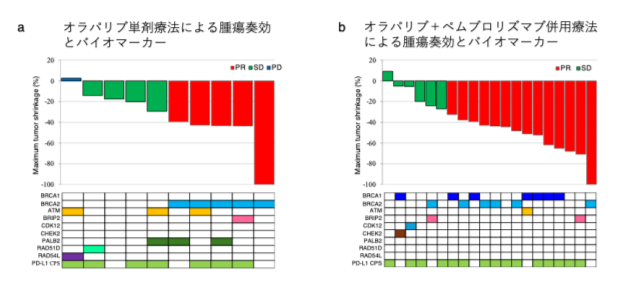
図:PARP阻害薬と免疫療法の効果
<関連情報>
- https://www.ncc.go.jp/jp/information/researchtopics/2026/1106/index.html
- https://aacrjournals.org/clincancerres/article-abstract/32/20/4580/788745/Neoadjuvant-Olaparib-and-Pembrolizumab-Combination
HRD陽性進行卵巣がん患者に対するオラパリブとペムブロリズマブの術前併用療法:パイロット研究 Neoadjuvant Olaparib and Pembrolizumab Combination Therapy in the Treatment of Patients with HRD-Positive Advanced Ovarian Cancer: A Pilot Study
Kenichi Harano; Takehiro Nakao; Shin Nishio; Takahiro Katsuda; Kazuto Tasaki; Kazuhiro Takehara; Takanori Yokoyama; Hideki Furuya; Kyoko Hongo; Masatoshi Asano; Takashi Ikeno; Masashi Wakabayashi; Akihiro Sato; Hitoshi Saito; Chiaki Mashima; Ryo Kamata; Akihiro Ohashi; Suguru Odajima; Hiroshi Tanabe; Tetsuro Taki; Yasuto Fujimoto; Hirohiko Miyake; Reiko Watanabe; Genichiro Ishii; Toru Mukohara
Clinical Cancer Research Published:October 15 2026
DOI:https://doi.org/10.1158/1078-0432.CCR-25-4887
Abstract
Preclinical studies suggest that poly (ADP-ribose) polymerase inhibition enhances tumor immunogenicity through stimulation of IFN genes pathway activation, providing rationale for combination with immune checkpoint inhibitors. However, clinical evidence supporting this synergy remains limited. We conducted a neoadjuvant pilot study evaluating olaparib with or without pembrolizumab in homologous recombination deficiency (HRD)–positive advanced ovarian cancer.
Patients with newly diagnosed, HRD-positive International Federation of Gynecology and Obstetrics stage III to IV high-grade serous or endometrioid ovarian cancer were enrolled. HRD status was determined using the Myriad MyChoice HRD Plus test. Patients received olaparib monotherapy (300 mg twice daily for 6 weeks; cohort 1, n = 10) or olaparib plus pembrolizumab (200 mg every 3 weeks for two cycles; cohort 2, n = 20), followed by surgery and platinum-based chemotherapy. The primary endpoint was the overall response rate (ORR). Exploratory IHC and single-cell RNA sequencing analyses assessed tumor microenvironmental changes.
The ORR was 50% [95% confidence interval (CI), 18.7–81.3] in cohort 1 and 70% (95% CI, 45.7–88.1) in cohort 2 (P = 0.2839). In cohort 1, responses occurred only in BRCA2-mutated tumors (5/5, 100%). In cohort 2, the ORR was 84.6% (11/13) in BRCA1/2-mutated tumors and 42.9% (3/7) in non–BRCA1/2-mutated tumors. Programmed cell death ligand 1 expression, tumor mutational burden, and microsatellite instability were not associated with response. Olaparib monotherapy did not increase tumor immunogenicity, whereas the combination increased CD8+ T-cell infiltration and immune-related transcriptional changes. No unexpected toxicities were observed.
Neoadjuvant olaparib showed measurable radiographic activity in HRD-positive advanced ovarian cancer. Pembrolizumab enhanced immune activation, but its impact on early clinical response seemed limited.