2026-11-19 北海道大学,室蘭工業大学,北海道教育大学
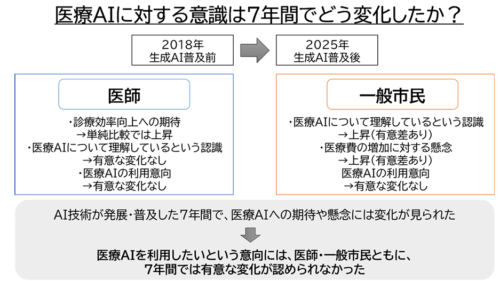
図1.医療AIに対する医師と一般市民の意識の変化(2018年・2025年)
<関連情報>
- https://www.hokudai.ac.jp/news/2026/11/ai20182025.html
- https://www.hokudai.ac.jp/news/pdf/261119_pr.pdf
- https://journals.plos.org/digitalhealth/article?id=10.1371/journal.pdig.0001769
日本の医師と一般市民における医療AIの受容意識の変化:2018年と2025年の反復横断比較
Changes in the acceptance of artificial intelligence in medicine among physicians and the general public in Japan: A repeated cross-sectional comparison of 2018 and 2025
Teppei Suzuki, Honoka Tamori, Kazuki Ohashi, Yasuhiro Morii, Kenji Hirata, Kohsuke Kudo, Katsuhiko Ogasawara
PLOS Digital Health, 5(10), e0001769 (2026)公開日:2026-10-23
DOI:10.1371/journal.pdig.0001769
本研究は、医療AIに対する日本の医師と一般市民の受容意識が、AI技術の普及した2018年から2025年にかけてどのように変化したかを検証したものである。研究チームは、2018年と2025年に同一の質問票を用いたオンライン調査を実施し、医師(2018年399名、2025年300名)と一般市民(各年600名、300名)の回答を比較した。調査では、医師の関与なしにAIが診断や治療方針を決定する比較的自律性の高い医療AIを対象とし、有用性、利用意向、安全性、信頼性、医療費など20項目を評価した。その結果、医療AIの利用意向は、医師・一般市民のいずれにおいても2018年から2025年にかけて有意な変化が認められなかった。一方、一般市民では医療AIに関する自己評価による知識が向上したものの、医療費を増加させるとの認識も強まった。医師では医療AIによる診療効率向上への期待が単純比較で上昇したが、年齢と性別を調整すると有意差は認められなかった。これらの結果は、AIに関する知識や社会的認知の向上が、必ずしも利用意向の増加につながらないことを示している。ただし、異なる時点の回答者を比較した反復横断研究であり、同一人物の意識変化を追跡したものではない。また、オンライン調査の参加者選択や医療AIの定義にも制約がある。医療AIの社会実装には、技術の有用性だけでなく、安全性、責任の所在、個人情報保護、医療費に関する懸念への対応が重要である。
This study examined changes in the acceptance of medical artificial intelligence (AI) among physicians and the general public in Japan between 2018 and 2025, a period of substantial advances and increasing societal exposure to AI. The researchers conducted repeated cross-sectional online surveys using the same questionnaire, comparing physicians (399 in 2018 and 300 in 2025) and members of the general public (600 in 2018 and 300 in 2025). The survey assessed 20 items covering perceived usefulness, intention to use, safety, reliability, and healthcare costs, focusing on relatively autonomous medical AI that determines diagnoses and treatment plans without physician involvement. The results showed no significant change in intention to use medical AI among either physicians or the general public between the two survey years. Among members of the public, self-rated knowledge of medical AI increased, but expectations that AI would increase healthcare costs also became stronger. Physicians initially showed higher expectations regarding improvements in clinical efficiency in the 2025 survey; however, this difference was no longer statistically significant after adjustment for age and sex. These findings indicate that increased knowledge and societal familiarity with medical AI do not necessarily translate into greater willingness to use AI-led healthcare. Nevertheless, the study relied on repeated cross-sectional online surveys rather than longitudinal follow-up of the same individuals, and its findings are subject to limitations related to participant selection and the relatively narrow definition of medical AI. Successful implementation will require addressing concerns about safety, accountability, personal data protection, and healthcare costs alongside improvements in technological capability.