2026-11-19 東京大学
<関連情報>
- https://www.t.u-tokyo.ac.jp/press/pr2026-11-19-001
- https://www.nature.com/articles/s41467-026-79805-x
任意の皮膚表面に超高密着ナノメッシュ表皮センサーをその場形成する技術(In-situ fabrication of ultra-conformal nanomesh epidermal sensors on arbitrary skin surface)
Xiaoping Liang, Ruiqi Guo, Hongting Chen, Yusaku Tagawa, Sunghoon Lee, Shuxu Wang, Buyun Yu, Masahito Takakuwa, Kento Yamagishi, Tomoyuki Yokota, Takuzo Aida, Yingying Zhang, Takao Someya
Nature Communications :Article in Press:2026-11-16
DOI:10.1038/s41467-026-79805-x
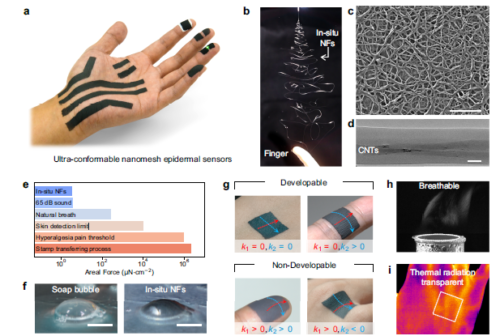
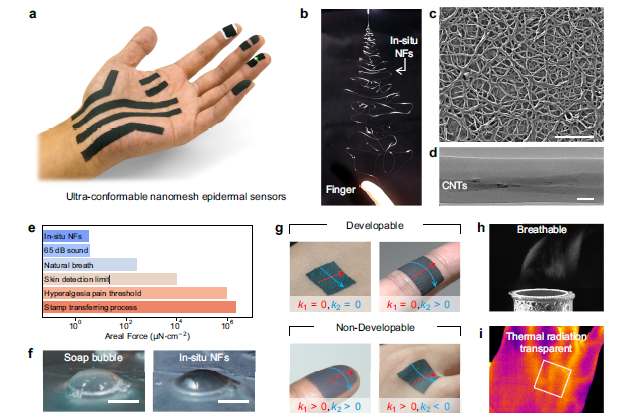
Fig. 1 In situ fabrication of nanomesh epidermal sensors on arbitrary skin surfaces.©Nature Communications CC BY-NC-ND 4.0
皮膚に装着するウェアラブルセンサーは、生体信号や身体活動を継続的に計測する技術として期待されている。しかし、従来の平面型電子デバイスは、皮膚の複雑な三次元形状、特に球面状などの展開できない曲面に完全に密着させることが難しく、装着性や長期安定性に課題があった。本研究では、皮膚表面に導電性ナノファイバーを直接形成することで、さまざまな形状の皮膚に密着する超薄型ナノメッシュセンサーを開発した。カーボンナノチューブを含む安定かつ均一なハイブリッド前駆体を用い、直径1マイクロメートル未満の導電性ナノファイバーを皮膚上で形成する技術を実現した。このナノメッシュは、多孔質構造によって高い通気性と放射冷却性能を備え、生体適合性と長期安定性も示した。さらに、この材料を用いて、心電図などの電気生理学的センサー、皮膚電気活動センサー、圧力センサーを作製し、複数のセンサーを組み合わせたアレイによる手のジェスチャー認識も実証した。深層学習アルゴリズムと組み合わせることで、身体の動作情報を取得・識別できることを示している。本技術は、皮膚の平面・曲面を問わずセンサーを直接形成できる点が特徴であり、ウェアラブル生体計測、健康モニタリング、ヒューマン・マシン・インターフェースなどへの応用が期待される。今後は、長期間の装着環境における耐久性や、実際の利用条件での計測精度の検証が重要となる。
Wearable epidermal sensors offer promising opportunities for continuous monitoring of physiological signals and human activities. However, conventional planar electronic devices often fail to conform perfectly to complex three-dimensional skin surfaces, particularly non-developable curved regions, limiting wearing comfort and long-term stability. This study presents an in situ fabrication strategy for highly conformal epidermal sensors based on conductive nanofibres formed directly on the skin. Using a stable and uniform carbon nanotube-based hybrid precursor, the researchers fabricated intrinsically conductive nanofibres with diameters below 1 μm. The resulting porous nanomesh conforms to both developable and non-developable surfaces and provides high gas permeability, efficient radiative heat dissipation, biocompatibility, and long-term stability. The platform was used to develop several types of epidermal sensors, including electrophysiological sensors, electrodermal activity sensors, and pressure sensors. The researchers also demonstrated a multichannel sensor array capable of recognizing hand gestures using a deep learning algorithm. This approach enables the direct formation of flexible sensing structures on skin surfaces with diverse geometries, potentially advancing wearable physiological monitoring, health tracking, and human–machine interfaces. Further studies are needed to establish durability during extended real-world use and measurement performance under practical wearing conditions.