2025-10-17 東京大学
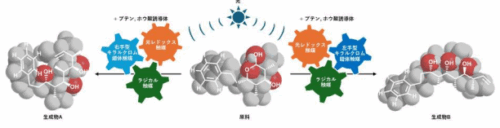
触媒でブテンを反応させてポリオールを作る
<関連情報>
- https://www.u-tokyo.ac.jp/focus/ja/press/z0111_00090.html
- https://www.u-tokyo.ac.jp/content/400272365.pdf
- https://www.science.org/doi/10.1126/science.adz0686
可視光駆動による環状ヘミアセタールとブテンの立体分岐アリル化によるポリプロピオネート合成 Visible light–driven stereodivergent allylation of cyclic hemiacetals with butene for polypropionate synthesis
Hiroyasu Nakao, Mirja Md Mahamudul Hassan, Yusuke Nakamura, Moe Toyobe, […] , and Motomu Kanai
Science Published:16 Oct 2025
DOI:10.1126/science.adz0686
Editor’s summary
Polypropionates are a class of natural product derivatives that feature alternating hydroxyl and methyl stereocenters on a carbon backbone. Targeting particular stereochemical distributions is an enduring challenge in their synthetic preparation for pharmaceutical research. Nakao et al. report a versatile route exploiting asymmetric chromium-catalyzed allylation paired with photoredox activation of simple butene reagents and a boron-promoted ring opening of a cyclic precursor. The protocol can be applied consecutively with tunable stereochemical selectivity in each successive iteration. —Jake S. Yeston
Abstract
Catalytically transforming abundant hydrocarbon feedstocks into structurally complex, high-value molecules is a pivotal yet challenging goal in organic synthesis. The key difficulty lies in the simultaneous activation of chemically inert feedstocks and precise stereochemical control. Here, we report a catalytic stereodivergent allylation of unprotected cyclic hemiacetal aldols with butene, enabling the programmable synthesis of polypropionates—privileged structural motifs prevalent in biologically active compounds, including pharmaceuticals. This visible light–driven, selective transformation exhibits broad functional group compatibility, furnishing 1,3-polyols with multiple contiguous stereocenters in high yield and stereochemical fidelity. Moreover, this method provides a concise and practical route to key natural product intermediates with minimal protection–deprotection sequences. This strategy has the potential to streamline polypropionate synthesis while reducing the time, cost, and environmental impact.