2026-06-26 東京大学
GM-CSF自己抗体の質が自己免疫性肺胞蛋白症の重症度を決定する
<関連情報>
- https://www.u-tokyo.ac.jp/focus/ja/press/z0406_00011.html
- https://www.nature.com/articles/s41467-026-74717-2
自己免疫性肺胞蛋白症患者におけるGM-CSF自己抗体の親和性およびエピトープ依存性病原性 Affinity- and epitope-dependent pathogenicity of GM-CSF autoantibodies in patients with autoimmune pulmonary alveolar proteinosis
Shinji Futami,Chie Kawai,Jun-ichi Kishikawa,Masaki Hirose,Hiroshi Kida,Po-hung Wang,Kazuo Yamashita,Fumihiko Ishikawa,Takayuki Kato,Yoshikazu Inoue,Atsushi Kumanogoh,Tomohiro Kurosaki & Takeshi Inoue
Nature Communications Published:26 June 2026
DOI:https://doi.org/10.1038/s41467-026-74717-2
Abstract
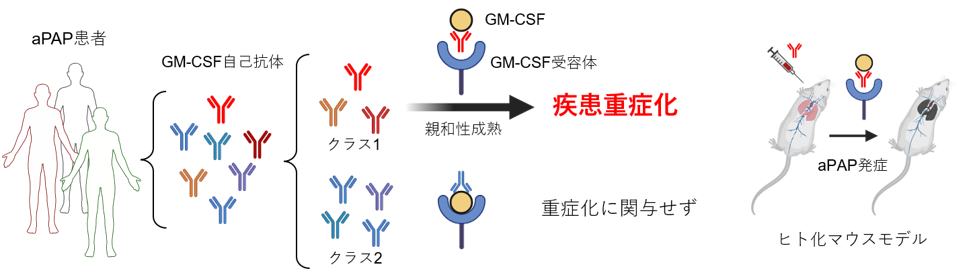
Autoimmune pulmonary alveolar proteinosis (aPAP) is a rare lung disease caused by autoantibodies targeting granulocyte-macrophage colony-stimulating factor (GM-CSF). Although serum GM-CSF autoantibody levels are markedly increased in aPAP patients, total antibody titer does not correlate with disease severity. Here, we characterize 186 monoclonal anti-GM-CSF autoantibodies derived from GM-CSF-specific B cells in 28 aPAP patients with varying disease severity, including three longitudinal cohorts, to determine whether epitope specificity and affinity of the autoantibodies contribute to disease pathophysiology. We classify these antibodies into two groups based on their epitopes: class 1 (targeting A, BD, or D epitopes) and class 2 (targeting B or C epitopes). In class 1 antibodies, affinity strongly correlates with neutralization activity, whereas this relationship is weak or absent in class 2 antibodies. High-affinity class 1 antibodies are present at higher levels in patients with more severe disease and are sufficient to induce PAP symptoms in a humanized mouse model. Thus, these findings identify epitope specificity and affinity as key determinants of pathogenicity and provide a mechanistic framework for understanding why total serum autoantibody levels fail to reflect disease severity in aPAP.