2026-07-06 ミュンヘン大学(LMU)
<関連情報>
- https://www.lmu.de/en/newsroom/news-overview/news/new-crispr-method-makes-it-possible-to-control-protein-production-in-cells-6bfaedb2.html
- https://www.science.org/doi/10.1126/science.aeh1348
CRISPRによるrRNA転写の活性化を介したタンパク質翻訳および幹細胞の自己複製操作 Manipulation of protein translation and stem cell self-renewal by CRISPR activation of rRNA transcription
Maximilian Wiesbeck, Emilie L. Alard, Florencia Merino, Niti Chowdhury, […] , and Stefan H. Stricker
Science Published:2 Jul 2026
DOI:https://doi.org/10.1126/science.aeh1348
Abstract
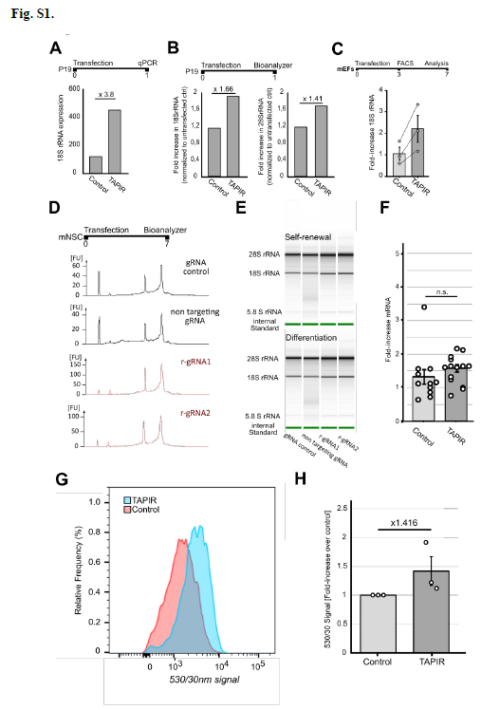
Ribosomal RNA (rRNA) transcription rates vary during development, and their dysregulation is linked to diseases such as cancer and ribosomopathies. Owing to their high abundance and genomic redundancy, the functional significance of rRNA-levels remains unclear. Here, we developed TAPIR (Targeted Activation of Protein Translation), a CRISPR-based approach to elevate rRNA-levels by inducing 47S rDNA transcription. TAPIR increased nucleolar size and enhanced protein synthesis, even in rapidly proliferating cells. In neural stem cells, elevated translation promoted self-renewal and proliferation in vitro and in vivo. Furthermore, TAPIR enabled the modeling and partial rescue of associated disease phenotypes. Our findings revealed that rRNA-levels directly regulate translational output and that protein synthesis capacity can act as a key determinant of mammalian stem cell behavior.