2026-07-10 中国科学院(CAS)
<関連情報>
- https://english.cas.cn/newsroom/research-news/202607/t20260707_1176391.shtml
- https://www.nature.com/articles/s41586-026-10623-3
視床と脳幹のアトラクターネットワークが、履歴に偏った意思決定を促す A thalamus–brainstem attractor network drives history-biased decisions
Shan Zhao,Heying Shan,Xiao Liu,Yu Qian,Jingyao Huang,Yi-Ran Liu,Zhenfei Jiao,Lichen Ye,Lin Cong,Xiaoou Wang,Zhi-Yuan Wang,Danyang Li,Ming-Quan Chen,Kai Wang,Ling Fu,Xu-Fei Du,Si Wu & Yu Mu
Nature Published:10 June 2026
DOI:https://doi.org/10.1038/s41586-026-10623-3
Abstract
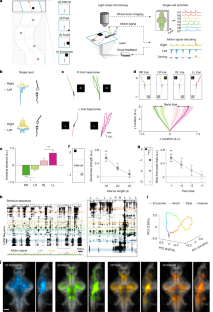
Natural environments often change gradually, making it adaptive to bias decisions on the basis of the recent past — a phenomenon known as serial dependence1,2,3. Large-scale recordings during behaviour have identified that serial dependence is a common motif for decision-making, with neural representations of past experiences found throughout the brain4,5,6,7,8,9,10,11. However, it remains unclear whether this bias arises from dedicated neural circuits with history-specific computations. Using whole-brain, cellular-resolution imaging in zebrafish performing memory-guided evasive manoeuvres12,13,14, we identified a hierarchical circuit that maintains past information and biases future choices. Discrete attractors in the dorsal thalamus encoded the position of the most recent obstacle, maintaining a categorical memory via persistent activity lasting 10–20 s. Optogenetic manipulation of the dorsal thalamus abolished or imposed serial bias. A downstream hindbrain integrator received input from the thalamus and combined it with current sensory cues to produce graded responses reflecting multi-trial history. Leveraging a comprehensive brain atlas in zebrafish15, we constructed a whole-brain computational model that recapitulated behaviour and also predicted a key role for heterogeneous inhibitory subtypes in enabling flexible state transitions. This attractor–integrator architecture reveals a hierarchical and modular computation that unifies robust memory retention with flexible sensory integration, providing a general principle for history-biased decisions.