2026-07-14 合肥物質科学研究院(HFIPS)
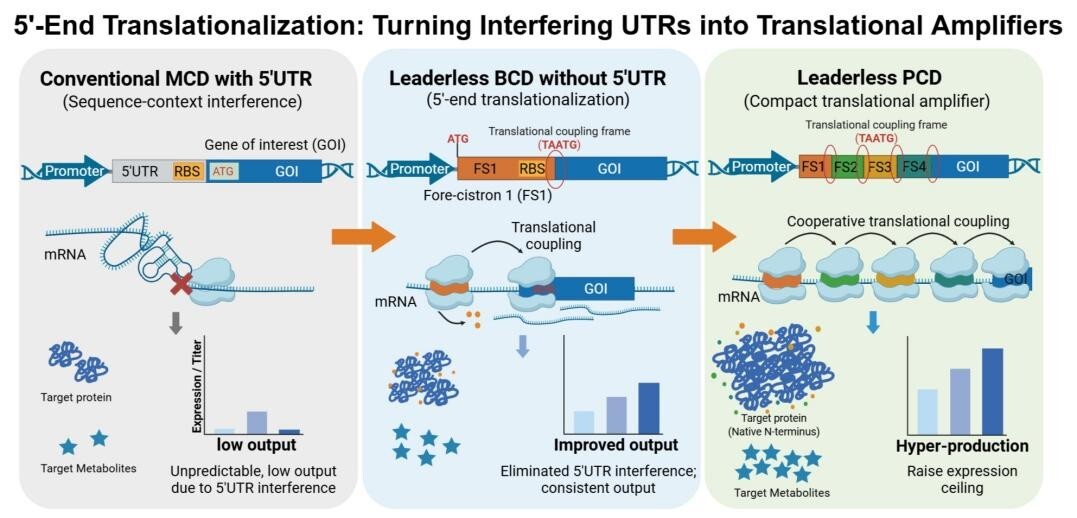
Leaderless polycistronic designs (PCDs) (Image by SUN Manman)
<関連情報>
- https://english.hf.cas.cn/nr/rn/202607/t20260714_1178337.html
- https://pubs.acs.org/doi/10.1021/acs.jafc.6c05362
5′末端翻訳:食品グレード細菌コリネバクテリウム・グルタミカムにおけるコンテキスト非依存的発現のためのリーダーレスポリシストロン増幅産物の反復アセンブリ 5′-End Translationalization: Iterative Assembly of Leaderless Polycistronic Amplifiers for Context-Independent Expression in the Food-Grade Bacterium Corynebacterium glutamicum
Manman Sun,Bin Ye,Yimeng Zhao,Rodrigo Ledesma-Amaro,Farkhod Eshboev,Alex Xiong Gao,and Peng Wang
Journal of Agricultural and Food Chemistry Published: June 17, 2026
DOI:https://doi.org/10.1021/acs.jafc.6c05362
Abstract
Corynebacterium glutamicum is a crucial food-grade (GRAS) bacterial chassis widely utilized for the industrial production of amino acids and nutraceuticals. However, the efficient production of recombinant proteins and secondary metabolites in this host remains limited by context dependence and low translational efficiency. To overcome this, we introduce a 5′-end translationalization strategy. By repurposing passive 5′ untranslated regions (5′UTRs) into actively translated fore-cistrons, we converted conventional monocistronic designs into context-independent, leaderless polycistronic designs (PCDs). This assembly of concatenated fore-cistrons functions as a translational amplifier, largely decoupling protein output from mRNA abundance. We validated this platform by optimizing two biomanufacturing paradigms: achieving a 4.07-fold enhanced secretion of OmlA, a porcine vaccine antigen, and boosting biosynthesis of the food-grade pigment indigoidine to 1.20 g/L (a 7.33-fold increase over baselines). Together, this framework establishes a versatile, portable toolkit to overcome translational bottlenecks, enabling robust hyperproduction of recombinant proteins and engineered metabolites in biotechnology.