2026-07-28 合肥物質科学研究院(HFIPS)
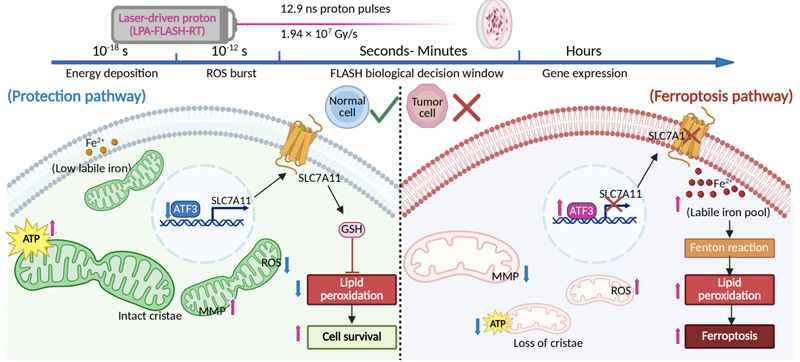
Schematic of Normal Tissue Sparing in Laser-Proton FLASH-RT (Image by SHAO Changsheng)
<関連情報>
- https://english.hf.cas.cn/nr/rn/202607/t20260728_1179305.html
- https://www.sciepublish.com/article/pii/1110
ナノ秒レーザー駆動プロトンFLASHは、ミトコンドリアの恒常性を維持し、フェロトーシスを抑制することで正常組織細胞を保護する Nanosecond Laser-Driven Proton FLASH Spares Normal Tissue Cells by Sustaining Mitochondrial Homeostasis and Attenuating Ferroptosis
Changsheng Shao, Yu Zhang, Pengzhi He, Xin Yu, Wenjie Peng, Junfeng Chen, Haotian Hu, Yiying Wang,Mei Xiao, Chao Liu, Li Sui, Tianyuan Dai, Xiangkui Mu, Xianghong Jia, Jian-Hui Bin, Qing Huang
iMed Published: 13 July 2026
DOI:https://doi.org/10.70322/iMed.2026.10006
ABSTRACT
Radiotherapy’s clinical utility remains fundamentally constrained by the collateral damage to healthy tissues. Ultra-high dose rate (UHDR) irradiation, or FLASH-radiotherapy (FLASH-RT) has emerged as a transformative paradigm to mitigate such toxicity. However, the biological effects of FLASH-RT on the high-efficiency of tumor killing and normal tissue sparing remain poorly understood. In this work, we utilized a petawatt-class laser-plasma acceleration (LPA) platform to deliver discrete 12.9-nanosecond proton pulses at an extreme instantaneous dose rate of 1.94 × 10⁷ Gy/s. This temporal singularity achieved a profound sparing effect in normal bronchial epithelial cells, evidenced by a nine-fold reduction in the lethal α coefficient (from 0.47 to 0.05 Gy−1), while maintaining full tumoricidal potency against lung adenocarcinoma. Mechanistically, we demonstrated that LPA-FLASH could effectively bypass the ATF3-mediated stress response and circumvent the subsequent ferroptotic cascade. This molecular evasion could preserve the mitochondrial cristae integrity and trigger an adaptive bioenergetic ATP surge—a hallmark of metabolic resilience exclusively in healthy tissue cells. Therefore, our findings identify ferroptosis-mediated mitochondrial integrity as a unifying framework for selective normal-tissue protection at the physical limits of radiation delivery, and establish LPA-FLASH-RT as a potent, compact modality for next-generation oncology.