
2026-08-13 スタンフォード大学
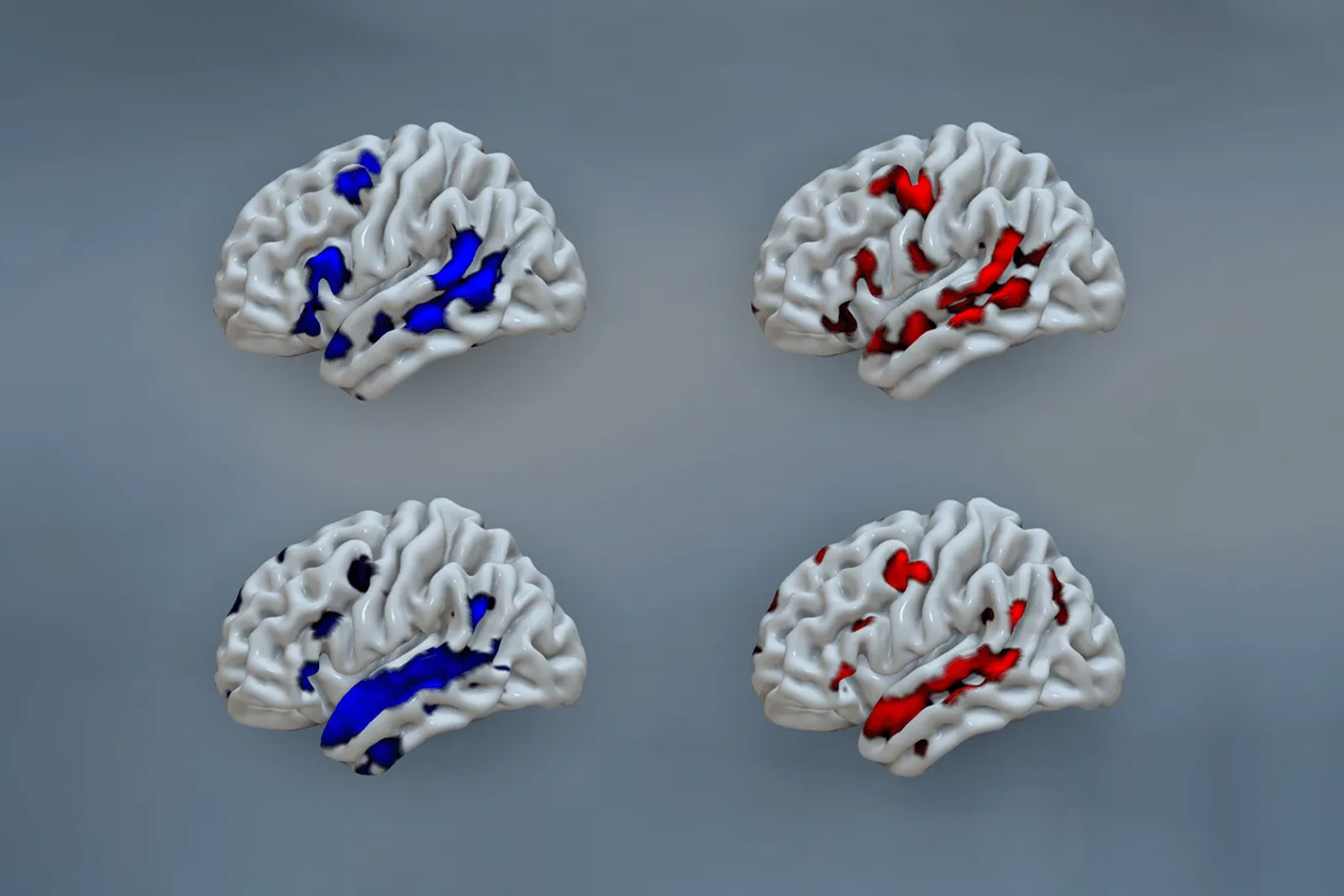
The language networks of two different individuals (top and bottom) were identified using two different methods (left and right). Scans identified the blue networks when the individuals were not performing language-related tasks and the red networks when they read sentences and then nonsense words. This illustrates how the language network can vary between individuals and how it can be identified without having an individual speak, read, or write. | Courtesy Stanford H&S
<関連情報>
- https://news.stanford.edu/stories/2026/08/language-specific-brain-network-research
- https://www.nature.com/articles/s41467-026-75745-8
任意のタスクを実行する1199人の人間の脳の個別化された機能的コネクトームにおける言語ネットワーク A language network in the individualized functional connectomes of 1199 human brains doing arbitrary tasks
Cory Shain & Evelina Fedorenko
Nature Communications Published:13 August 2026
DOI:https://doi.org/10.1038/s41467-026-75745-8
Abstract
A century and a half of neuroscience has yielded many divergent theories of the neurobiology of language. Two factors that likely contribute to this situation include (a) conceptual disagreement about language and its component processes, and (b) intrinsic inter-individual variability in the topography of language areas. Recent functional magnetic resonance imaging (fMRI) studies of small numbers of intensively scanned individuals have argued that a language-selective brain network emerges bottom-up from correlations (individualized functional connectomics, iFC) in task-free (e.g., rest) or task-regressed activation timecourses. Here we tested this hypothesis at scale and evaluated its practical utility for task-agnostic language localization: we apply iFC separately to each of 1,957 (fMRI) scanning sessions (1,199 unique brains), each consisting of diverse tasks. We found that iFC indeed revealed a largely left-hemisphere-dominant frontotemporal network that was more stable within individuals than between them, robust to the granularity of the parcellation, and selective for language. These results support the hypothesis that this network is a key structure in the functional organization of the adult brain and show that it can be recovered retrospectively from arbitrary imaging data, with implications for neuroscience, neurosurgery, and neural engineering.

