2026-09-04 清華大学
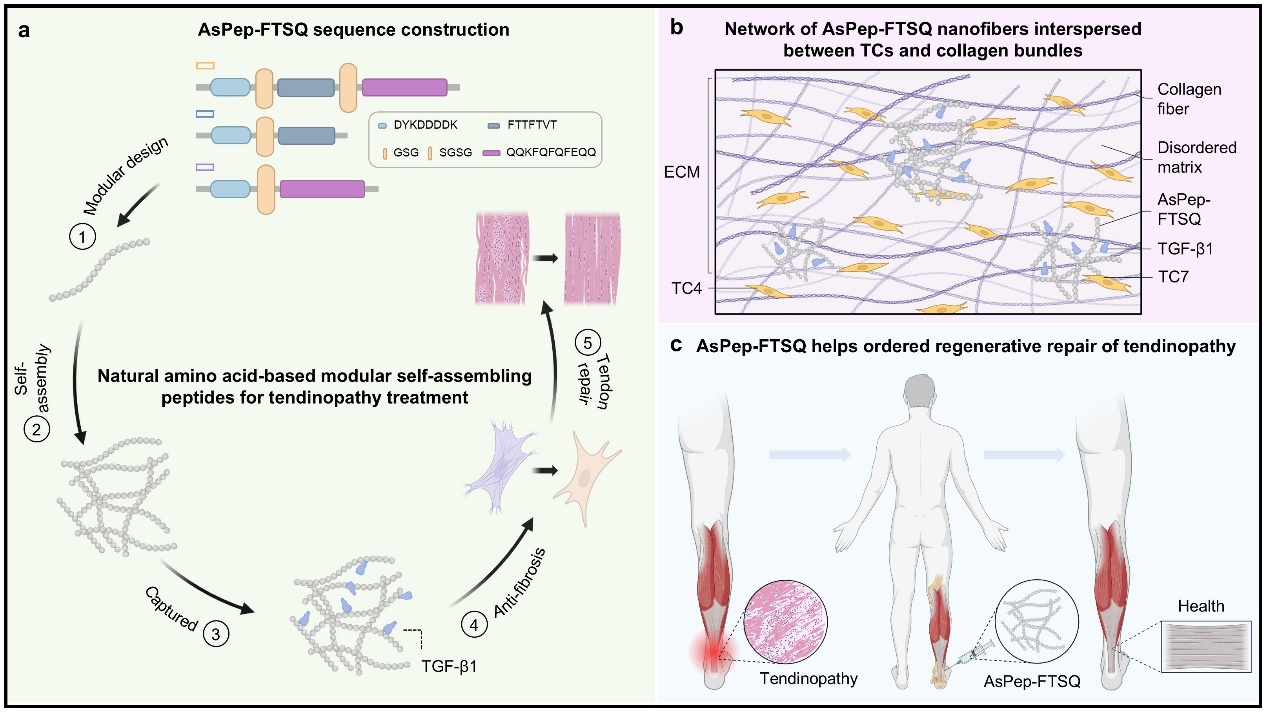
Fig. 1 | AsPep-FTSQ self-assembles into a nanofibrous network in diseased tendon tissue, sequestering excess TGF-β1 and promoting organized tendon regeneration.
<関連情報>
- https://www.tsinghua.edu.cn/en/info/1245/15027.htm
- https://www.nature.com/articles/s41467-026-76487-3
腱再生のためのTGF-β1を標的とするモジュール型自己組織化ペプチドプラットフォーム A modular self-assembling peptide platform targeting TGF-β1 for tendon regeneration
Chao Li (李超),Zehao Chen (陈泽昊),Wentao Li (李文韬),Ronghui Deng (邓荣辉),Lingan Huang (黄凌岸),Yifan Song (宋一凡),Yiqun Wang (王逸群),Guoqing Cui (崔国庆),Huawei Liu (刘华玮) & Jiakuo Yu (余家阔)
Nature Communications Published:11 August 2026
DOI:https://doi.org/10.1038/s41467-026-76487-3 Early provide
Abstract
Excessive transforming growth factor-β1 (TGF-β1) signaling is a key driver of the pathological processes of fibrosis and matrix disorganization in tendinopathy, yet current treatments do not directly target this fibrotic microenvironment. Here we show that a self-assembling peptide composed entirely of natural amino acids, AsPep-FTSQ, can locally capture TGF-β1 and remodel the pathological tendon niche. Injecting AsPep-FTSQ into rat and beagle models of tendinopathy resulted in the formation of an interconnected nanofibrous network in situ that selectively sequesters excess TGF-β1. This network suppresses pro-fibrotic signaling, limits pathological tendon cell (TC) state transitions, and promotes collagen realignment. These effects improve tendon structure and functional repair across species. This fully natural, self-assembling peptide composed of amino acids provides a modular strategy for local cytokine sequestration and suggests a therapeutic approach for tendinopathy and potentially other fibrotic soft-tissue disorders.