2026-09-04 中国科学院(CAS)
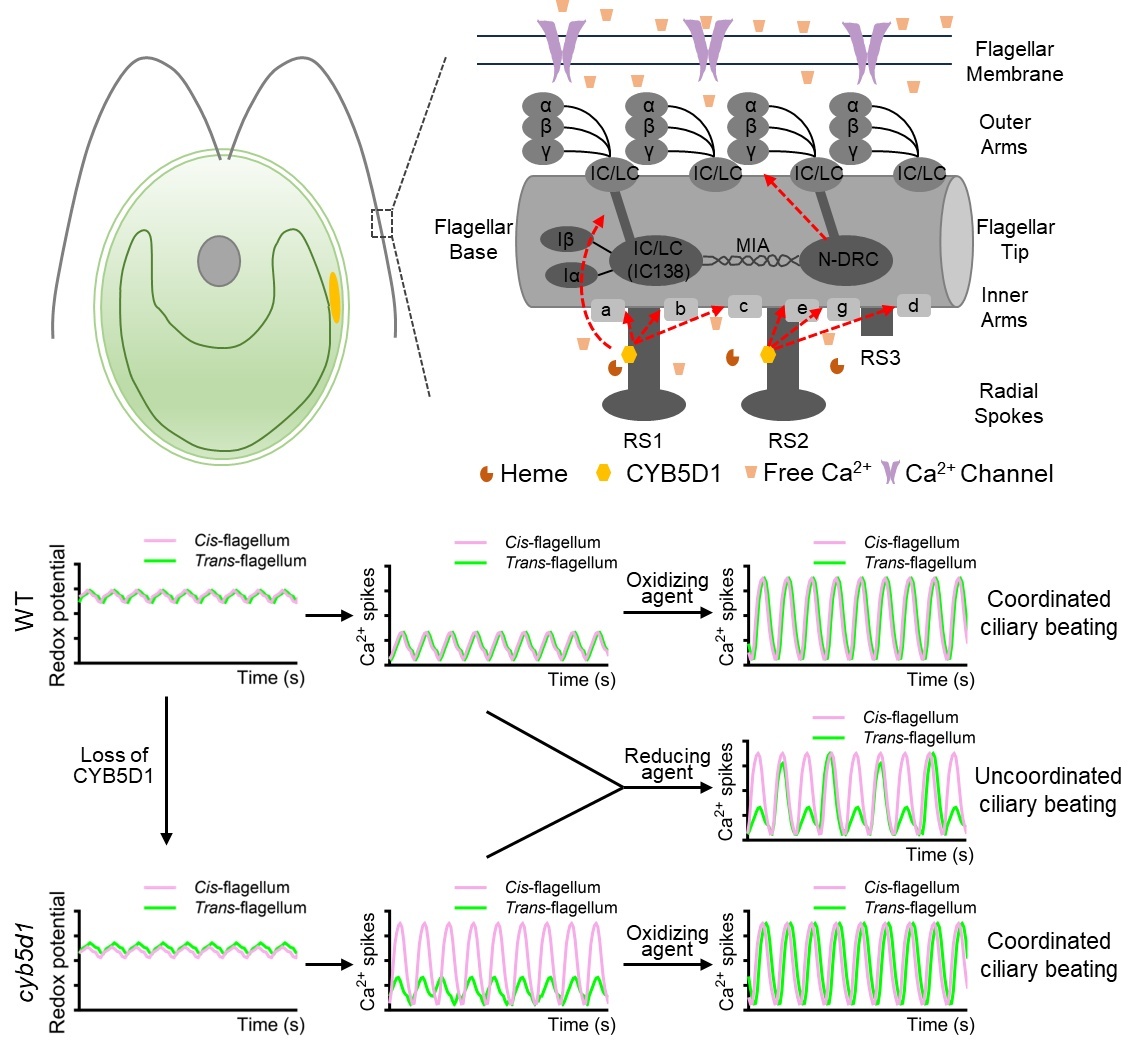
CYB5D1 integrates redox signals to control Flagellar coordination through calcium dynamics. (Image by IHB)
<関連情報>
- https://english.cas.cn/newsroom/research-news/202609/t20260904_1192605.shtml
- https://www.pnas.org/doi/10.1073/pnas.2535939123
ヘム結合タンパク質CYB5D1は、鞭毛内部の酸化還元反応とカルシウムシグナル伝達を連結し、鞭毛の協調的な拍動を実現する Heme-binding protein CYB5D1 couples intraflagellar redox to calcium signaling for coordinated flagellar beating
Yiwen Lin, Lijuan Zhao, Gai Liu, +2 , and Kaiyao Huang
Proceedings of the National Academy of Sciences Published:August 19, 2026
DOI:https://doi.org/10.1073/pnas.2535939123
Abstract
Coordinated ciliary/flagellar beating requires precise spatiotemporal regulation of molecular motors such as dyneins, yet the molecular mechanisms governing ciliary synchrony remain poorly understood. Here, we demonstrate that a heme-binding axonemal protein CYB5D1 functions as a redox-sensitive switch that controls flagellar beating coordination by regulating Ca2+ dynamics. Both the D58G point mutation, which abolishes heme-binding activity, and the complete loss of CYB5D1 lead to a reduction in the flagellar redox potential. More importantly, the hyperreductive intraflagellar redox shift in the cyb5d1 mutant increases cis-flagellar Ca2+ spike frequency and amplitude, similar to reductive treatment of wild-type flagella, resulting in the loss of flagellar beating coordination. Interestingly, oxidative treatments induced synchronized Ca2+ spikes across both cis– and trans-flagella of cyb5d1 and increased flagellar beating coordination. In addition, loss of CYB5D1 raised the intraflagellar Ca2+ pool. These results indicate that CYB5D1 links redox sensing to Ca2+ signaling in ciliary coordination and reveal how the two flagella of the same cell achieve synchronized beating through redox-gated Ca2+ dynamics. Furthermore, CYB5D1 loss impairs gliding motility by dysregulating Ca2+ spiking specifically in the leading flagellum, extending the redox-Ca2+ regulatory axis to surface-associated flagellar behaviors. Given the evolutionary conservation of both CYB5D1 and the redox-Ca2+ signaling axis, this mechanism likely regulates ciliary function across eukaryotes, with implications for understanding ciliopathies and respiratory diseases.