2026-09-17 国立精神・神経医療研究センター
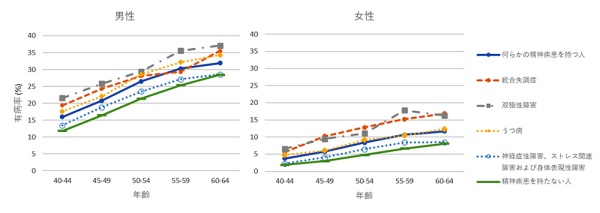
図1.メタボリックシンドローム有病率
<関連情報>
- https://www.ncnp.go.jp/topics/detail.php?@uid=HVyDzm1z09SzZdEI
- https://www.sciencedirect.com/science/article/pii/S016517812600452X
日本における精神疾患患者におけるメタボリックシンドロームの有病率:全国健康保険請求データおよび健康診断データを用いた横断研究 Prevalence of metabolic syndrome among people with psychiatric disorders in Japan: A cross-sectional study using nationwide health insurance claims and health check-up data
Maiko Fukasawa, Kentaro Usuda, Mayumi Kataoka, Naoaki Kuroda
Psychiatry Research Available online: 14 August 2026
DOI:https://doi.org/10.1016/j.psychres.2026.117392
Highlights
- Metabolic syndrome was more common in psychiatric patients than general population.
- Elevated risk in psychiatric patients was observed at all ages in both sexes.
- Elevated risk was confirmed in schizophrenia, bipolar disorder, and depression.
- Elevated risk was detected in developmental disorders and intellectual disabilities.
- Large-scale health insurance claims and health check-up database in Japan.
Abstract
Psychiatric disorders increase the risks of lifestyle-related diseases. This study revealed the prevalence of metabolic syndrome across a spectrum of psychiatric diagnoses and compared it to that of those without psychiatric disorders. We utilized the JMDC Claims database, which accumulates health insurance claims and health check-up data from multiple health insurance associations in Japan. The number of individuals aged 40–64 years who were continuously in the database from April 2023 to March 2024 totaled 4815,834. Among them, those with any psychiatric disorders were 198,692 (4.13%). Health check-up recipients among those with and without psychiatric disorders were 153,222 (77.12%) and 3629,155 (83.59%), respectively. We used this data to calculate the sex-stratified, age-adjusted prevalence of metabolic syndrome and its related risk factors. The prevalences of metabolic syndrome among those with and without psychiatric disorders were 24.81% and 20.34%, respectively, in men, and 7.77% and 4.60%, respectively, in women. The prevalence of metabolic syndrome increased with age and was consistently higher among those with psychiatric disorders. Higher prevalence of metabolic syndrome was confirmed among individuals with schizophrenia, bipolar disorder, and depressive disorder. The prevalence was especially high in men with organic mental disorders and post-traumatic stress disorder, and in women with organic mental disorders, intellectual disabilities, and developmental disorders. The prevalence of individual metabolic abnormalities was also higher among those with psychiatric disorders than those without, except for high blood pressure. Providing treatments for psychiatric conditions alongside monitoring metabolic syndrome and its components may benefit in preventing lifestyle-related diseases and premature mortality.