2026-11-09 東京大学
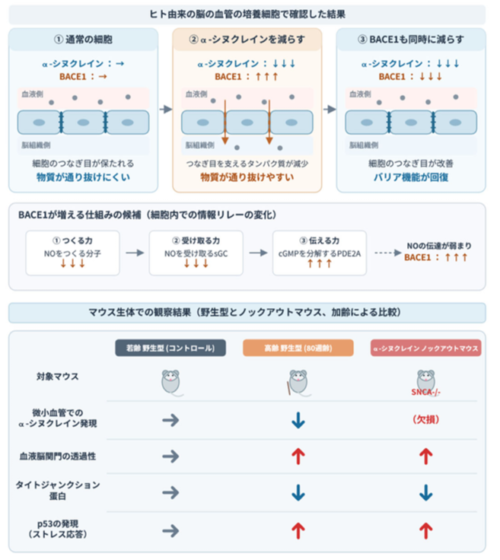
図1 概要図
<関連情報>
- https://www.h.u-tokyo.ac.jp/press/20261109.html
- https://www.h.u-tokyo.ac.jp/press/__icsFiles/afieldfile/2026/11/09/release_20261109.pdf
- https://onlinelibrary.wiley.com/doi/10.1111/acel.70770
脳微小血管内皮におけるα-シヌクレインの老化に伴う喪失は、タイトジャンクションを損ない、血液脳関門の完全性を破壊する Senescence-Associated Loss of α-Synuclein in Brain Microvascular Endothelium Compromises Tight Junctions and Disrupts Blood–Brain Barrier Integrity
Ziwei Wang, Yoichi Takami, Cheng Wang, Yoshitaka Kase, Hiroshi Koriyama, Jittoku Ihara, Yu Guo, Weidong Liu, Nanxiang Yin, Lisha Yi, Daisuke Nawa, Hikari Takeshita, Shuko Takeda, …
Aging Cell Published: 09 November 2026
DOI:https://doi.org/10.1111/acel.70770
Abstract
Blood–brain barrier (BBB) dysfunction is an early feature of brain aging, but the endothelial mechanisms preserving barrier resilience remain unclear. Although we have reported α-synuclein (SNCA) supports vascular endothelial homeostasis, its role in the brain microvascular endothelium is unknown. Because SNCA loss suppresses eNOS/NO signaling and promotes endothelial β-site amyloid precursor protein cleaving enzyme 1 (BACE1) induction, we investigated whether senescence-associated SNCA decline drives BACE1-dependent BBB injury. Replicative senescence in human brain microvascular endothelial cells (HBMECs) reduced SNCA expression. siRNA-mediated SNCA depletion induced a senescence-like state with increased β-galactosidase activity, CDKN2A/p16 and TP53/p53 induction, and decreased SIRT1, eNOS, and glypican-1. SNCA-deficient HBMECs showed impaired proliferation and migration, loss of occludin and ZO-1, increased permeability, and elevated BACE1 expression and activity; BACE1 co-silencing restored junctional proteins and normalized permeability. Transcriptomic and proteomic profiling excluded most classical BACE1-regulatory mechanisms and instead implicated coordinated disruption of the NO–sGC–cGMP axis, consistent with the partial rescue by the NO donor SNAP. Amyloid-β42 oligomers sensitized SNCA-deficient monolayers to barrier injury at concentrations that left control monolayers unaffected. Global SNCA-knockout mice exhibited multiregional BBB leakage, reduced occludin, ZO-1, and claudin-5, and p53 immunoreactivity confined to CD31-positive microvessels. This phenotype was present in young adulthood and was reproduced in aged wild-type mice, which showed reduced SNCA in isolated brain microvessels. These findings identify senescence-associated endothelial SNCA loss as a candidate contributor to brain microvascular barrier vulnerability, describing an endothelial stress pathway in which SNCA insufficiency is associated with BACE1-dependent tight junction destabilization in the aging brain.