
2025-06-26 マックス・プランク研究所
<関連情報>
- https://www.mpg.de/24962116/flowering-plants-use-a-pseudoenzyme-to-form-indole
- https://www.nature.com/articles/s41589-025-01943-y
擬似酵素が双子葉植物におけるインドール生合成を可能にする A pseudoenzyme enables indole biosynthesis in eudicot plants
Matilde Florean,Hedwig Schultz,Veit Grabe,Katrin Luck,Grit Kunert,Sarah E. O’Connor & Tobias G. Köllner
Nature Chemical Biology Published:25 June 2025
DOI:https://doi.org/10.1038/s41589-025-01943-y
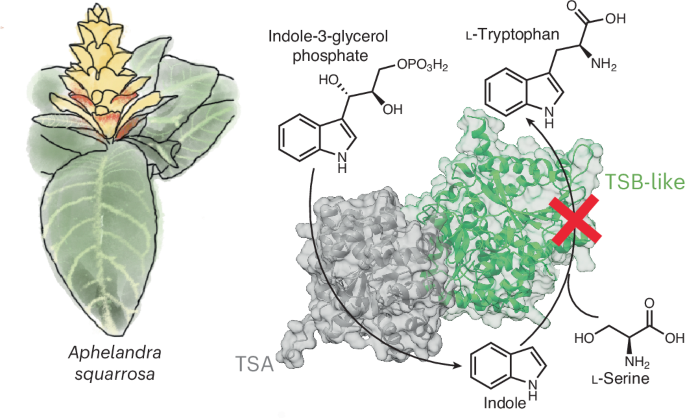
Abstract
Indole is an important biomolecule in plants, essential for amino acid biosynthesis, defense, pollinator attraction and plant–plant communication. Its biosynthesis is reported to be catalyzed by standalone indole-3-glycerol phosphate lyases, which are, however, absent in core eudicots. Here we show that, in core eudicots, indole production for defense and signaling occurs through an alternative pathway. The tryptophan synthase α subunit (TSA), which is typically complexed with the β subunit (TSB) to synthesize tryptophan through indole as an intermediate, can be hijacked by a noncatalytic paralog of TSB (TSB-like) to produce free indole. TSB-like is a pseudoenzyme that evolved from TSB by mutagenesis of two key essential residues, retaining the ability to allosterically activate TSA to allow formation and release of indole. The widespread occurrence and expression pattern of TSB-like genes in plants suggest that this is a general mechanism for the formation of free indole in plant defense and communication.

