
2025-11-07 中国科学院(CAS)
<関連情報>
- https://english.cas.cn/newsroom/cas_media/202511/t20251107_1096692.shtml
- https://pubs.acs.org/doi/10.1021/acs.est.5c09617
超蓄積植物におけるナノスケール希土類鉱物の発見とその意義 Discovery and Implications of a Nanoscale Rare Earth Mineral in a Hyperaccumulator Plant
Liuqing He,Haiyang Xian,Yiping Yang,Jielong Cao,Hongmei Yang,Jieyang Xie,Jiaxin Xi,Yixuan Yang,Shan Li,Runliang Zhu,Xiaoliang Liang,Hongping He,Michael F. Hochella Jr.,and Jianxi Zhu
Environmental Science &Technology Published: November 4, 2025
DOI:https://doi.org/10.1021/acs.est.5c09617
Abstract
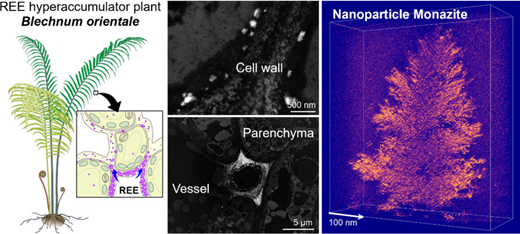
Rare earth elements (REEs) are critical metals for clean energy and high-tech applications, yet their supply faces environmental and geopolitical challenges. Phytomining, a green strategy using hyperaccumulator plants to extract metals from soil, offers potential for sustainable REE supply but remains underexplored. Here, we report the discovery of naturally formed nanoscale monazite in the fern Blechnum orientale, a REE hyperaccumulator plant. These REE minerals crystallize within extracellular tissues under ambient conditions, forming dendritic nanocrystals through biologically induced mineralization coupled with a non-equilibrium self-organization process. This represents the novel discovery of REE mineral crystals formed in living plants through a phytomineralization (i.e., plant-mediated mineralization) process. Our findings uncover a previously unrecognized, plant-mediated pathway for critical mineral formation in a supergene environment. This discovery not only sheds light on REE enrichment and sequestration during chemical and biological weathering but also opens new possibilities for the direct recovery of functional REE materials. This work substantiates the feasibility of phytomining and introduces an innovative, plant-based approach for sustainable REE resource development.

