
2025-11-12 京都大学
Web要約 の発言:

BioRenderにより作製
<関連情報>
- https://www.kyoto-u.ac.jp/ja/research-news/2025-11-12
- https://www.kyoto-u.ac.jp/sites/default/files/2025-11/2511_EmbRep_Ikeda_relj%20web_-54b591d4f7c0a525ba471bb959a078fe.pdf
- https://www.embopress.org/doi/full/10.1038/s44319-025-00611-5
遊離脂肪酸受容体GPR164は腸の恒常性とバリア機能を維持する The free fatty acid receptor GPR164 maintains intestinal homeostasis and barrier function
Takako Ikeda, Yuki Masujima, Keita Watanabe, Akari Nishida, Mayu Yamano, Miki Igarashi, Nobuo Sasaki, Hironori Katoh, and Ikuo Kimura
EMBO Reports Published:28 October 2025
DOI:https://doi.org/10.1038/s44319-025-00611-5
Abstract
GPR164 is a free fatty acid receptor, activated by both short-chain fatty acids and medium-chain fatty acids, and expressed throughout the gastrointestinal tract. Although GPR164 is reported to be involved in the release of gut hormones, the physiological functions of this receptor in the maintenance of intestinal homeostasis remain unclear. In this study, we explore the role of GPR164 in regulating intestinal barrier function using mice lacking Gpr164 gene (Gpr164-/-). A loss-of-function mutation in Gpr164 promotes cell proliferation and disrupts the intestinal barrier function in both Caco-2 cells and mice. Genome-wide RNA-seq analysis reveals that Gpr164 deletion causes aberrant Wnt/β-catenin signaling, and the intraperitoneal injection of the Wnt/β-catenin inhibitor PNU-74654 ameliorates intestinal hyperproliferation, differentiation and barrier permeability phenotypes of Gpr164-/- mice. Gpr164-/- mice also exhibit gut microbial dysbiosis and inflammation. Thus, our findings uncover the pivotal role of GPR164 in the maintenance of intestinal homeostasis through regulating barrier function.
Synopsis
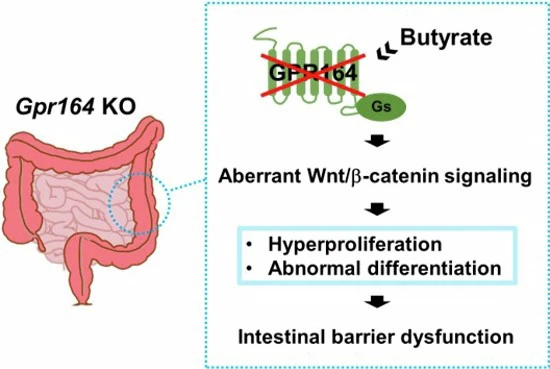
The free fatty acid receptor GPR164 is activated by butyrate in the colon. Deletion of the receptor in mice causes intestinal hyperproliferation and abnormal epithelial differentiation, leading to intestinal barrier dysfunction.
- Gpr164 loss-of-function promotes cell proliferation and disrupts intestinal barrier function in both Caco-2 cells and mice.
- Gpr164 deletion causes aberrant Wnt/β-catenin signaling.
- GPR164 maintains intestinal homeostasis by regulating barrier function.

