2025-12-23 総合地球環境学研究所
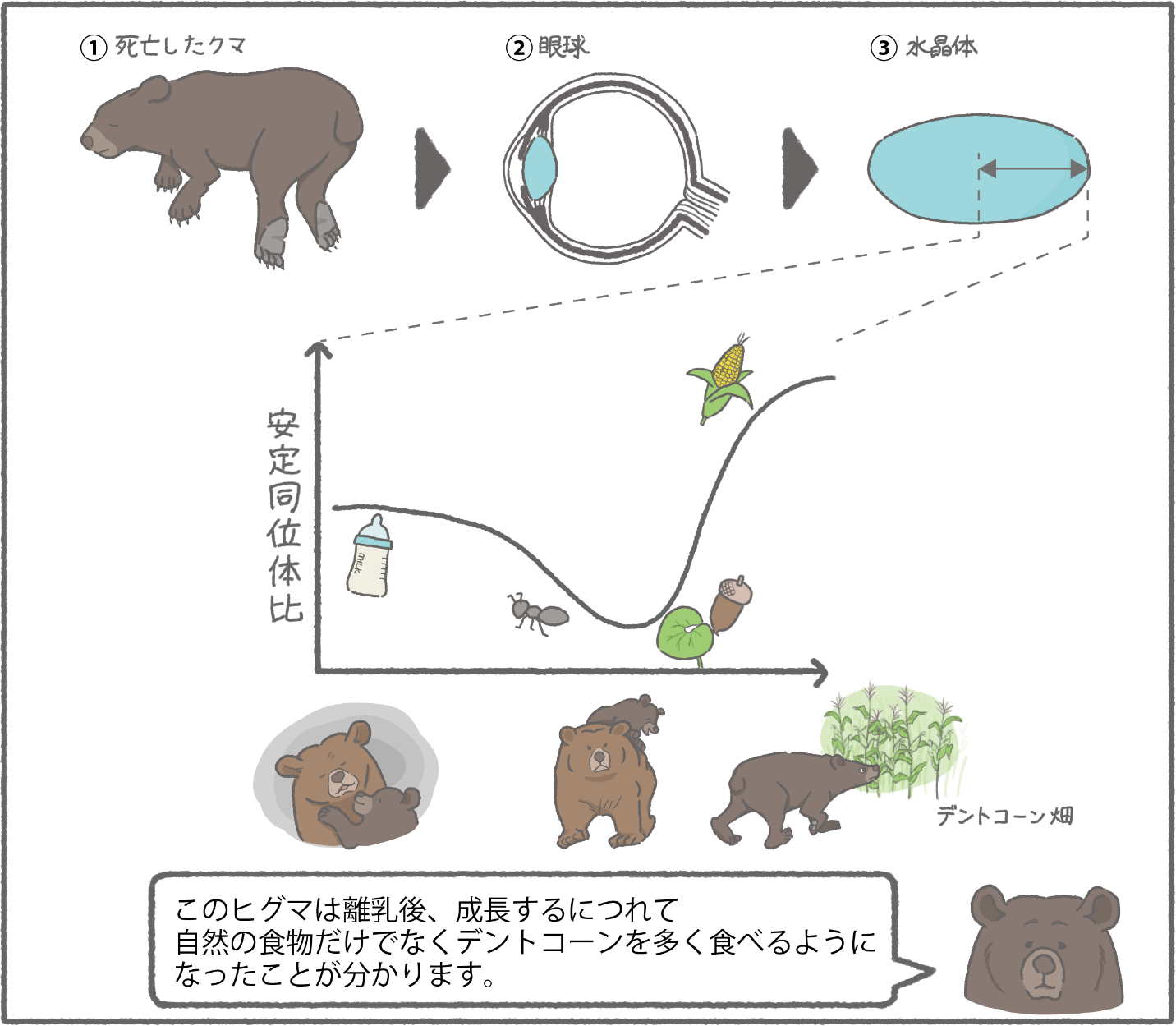
(イラスト:中島あかり)
<関連情報>
- https://www.chikyu.ac.jp/rihn/news/detail/706/
- https://www.chikyu.ac.jp/rihn/cms_upload/news/706/Press_Release_20251223.pdf
- https://esajournals.onlinelibrary.wiley.com/doi/10.1002/ecs2.70276
哺乳類の眼球レンズを用いた微細スケールの遡及的同位体分析のための新しい方法 A novel method for fine-scale retrospective isotope analysis in mammals using eye lenses
Kazuki Miura, Jun Matsubayashi, Chikage Yoshimizu, Hino Takafumi, Yuri Shirane, Tsutomu Mano, Hifumi Tsuruga, Ichiro Tayasu
Ecosphere Published: 26 May 2025
DOI:https://doi.org/10.1002/ecs2.70276
Abstract
Understanding individual variations in animal behavior is crucial for ecology, evolution, conservation, and wildlife management. However, traditional bio-logging methods have often impeded the reconstruction of long-term behavioral patterns in mammals because of cost, battery life, and device size constraints. This study proposes and evaluates a novel method using retrospective isotope analysis of eye lenses to reconstruct mammalian feeding history, focusing on brown bears (Ursus arctos). We devised a protocol for longitudinal segregation of fragile mammalian lenses and sequentially analyzed lens fragments for carbon and nitrogen stable isotope ratios (δ13C and δ15N, respectively) in seven bears. We verified the reproducibility of the protocol by comparing isotopic patterns within lens pairs of the same bear. The results successfully reconstructed time-series feeding histories, capturing dietary shifts during the lactation-weaning process, reflected by δ15N from all bears and changes in corn crop (Zea mays) consumption primarily indicated by δ13C from nuisance bears. The reconstructed δ15N lactation-weaning signal suggested that higher-resolution isotopic information is preserved for 1–2 years after birth, with resolution declining as eye lens growth slows. The similarity of patterns between the same lens pairs supports the reliability of the method. This novel approach for reconstructing the time-series feeding history of various mammals is simple and effective.