2026-02-20 沖縄科学技術大学院大学(OIST)
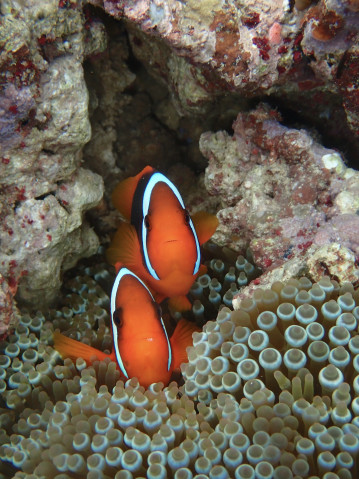
ハマクマノミ(Amphiprion frenatus)は稚魚期に2本の白い縦帯の縞模様を持つが、成長に伴いそのうち1本を失う。この変化のタイミングは柔軟で、さまざまな環境や社会的な要因によって左右される。OISTの研究チームは新たな研究で、この変化をもたらす要因と、その背後にある細胞メカニズムを明らかにした。© カミュ・ソトロー
<関連情報>
- https://www.oist.jp/ja/news-center/news/2026/2/20/social-pressure-forces-baby-clownfish-lose-their-bars-faster
- https://journals.plos.org/plosbiology/article?id=10.1371/journal.pbio.3003630
- https://journals.biologists.com/jeb/article/227/2/jeb246357/342628/Counting-Nemo-anemonefish-Amphiprion-ocellaris
イソギンチャク魚において虹彩細胞のアポトーシスが社会的に制御された発達的色彩パターン可塑性を媒介する Iridophore apoptosis mediates socially-regulated developmental color pattern plasticity in an anemonefish
Laurie J. Mitchell ,Saori Miura,Youjung Han,Jann Zwahlen,Camille A. Sautereau,Bruno Frédérich,Vincent Laudet
PLOS Biology Published: February 19, 2026
DOI:https://doi.org/10.1371/journal.pbio.3003630
Abstract
Understanding the developmental basis of phenotypic plasticity is key to unraveling the origins of biodiversity. In coral reef fishes, color pattern changes during ontogeny can serve adaptive functions, yet the mechanisms and ecological contexts shaping these transitions remain largely unknown. Here, we investigated color pattern development in the tomato anemonefish (Amphiprion frenatus), which exhibits transient posterior white barring during early juvenile stages. We demonstrated that the timing of bar loss is plastic and modulated by the social environment, where juveniles cohabiting with adult conspecifics exhibited bar loss ~24 days earlier than those isolated from adults. Through transcriptomic profiling, we identified gene expression changes implicating apoptosis- and autophagy-related pathways, as well as alterations in chromatophore development. Moreover, shifts in the expression of multiple thyroid hormone marker genes highlighted the potential neuroendocrinal integration of social cues that promoted bar loss. Ultrastructural analyses via transmission electron microscopy and in-situ assays indicated massive apoptosis of iridophores and associated dermal remodeling during the white-to-orange transition. The pharmacological inhibition of caspases delayed bar loss, confirming the functional role of programmed cell death. Behavioral trials revealed that adults responded differently to juveniles with/without the posterior bar, suggesting a role of transient barring in conflict avoidance during recruitment. Lastly, our evolutionary reconstruction of this plastic trait suggests that colony size is an important factor promoting this ontogenetic switch throughout anemonefishes. Our results provide compelling evidence for socially mediated plasticity in color pattern ontogeny with ecological and evolutionary implications for communication and species diversification in reef fishes.
ニモを数える:クマノミAmphiprion ocellaris は白いバーの数で種を識別します Counting Nemo: anemonefish Amphiprion ocellaris identify species by number of white bars
Kina Hayashi,Noah J. M. Locke,Vincent Laudet
Journal of Experimental biology Published:01 February 2024
DOI:https://doi.org/10.1242/jeb.246357
ABSTRACT
The brilliant colors of coral reef fish have received much research attention. This is well exemplified by anemonefish, which have distinct white bar patterns and inhabit host anemones and defend them as a territory. The 28 described species have between 0 and 3 white bars present, which has been suggested to be important for species recognition. In the present study, we found that Amphiprion ocellaris (a species that displays three white bars) hatched and reared in aquaria, when faced with an intruder fish, attacked their own species more frequently than other species of intruding anemonefish. Additionally, we explicitly tested whether this species could distinguish models with different numbers of bars. For this, 120 individuals of A. ocellaris were presented with four different models (no bars, and 1, 2 and 3 bars) and we compared whether the frequency of aggressive behavior towards the model differed according to the number of bars. The frequency of aggressive behavior toward the 3-bar model was the same as against living A. ocellaris, and was higher than towards any of the other models. We conclude that A. ocellaris use the number of white bars as a cue to identify and attack only competitors that might use the same host. We considered this as an important behavior for efficient host defense.