2026-03-05 中国科学院(CAS)
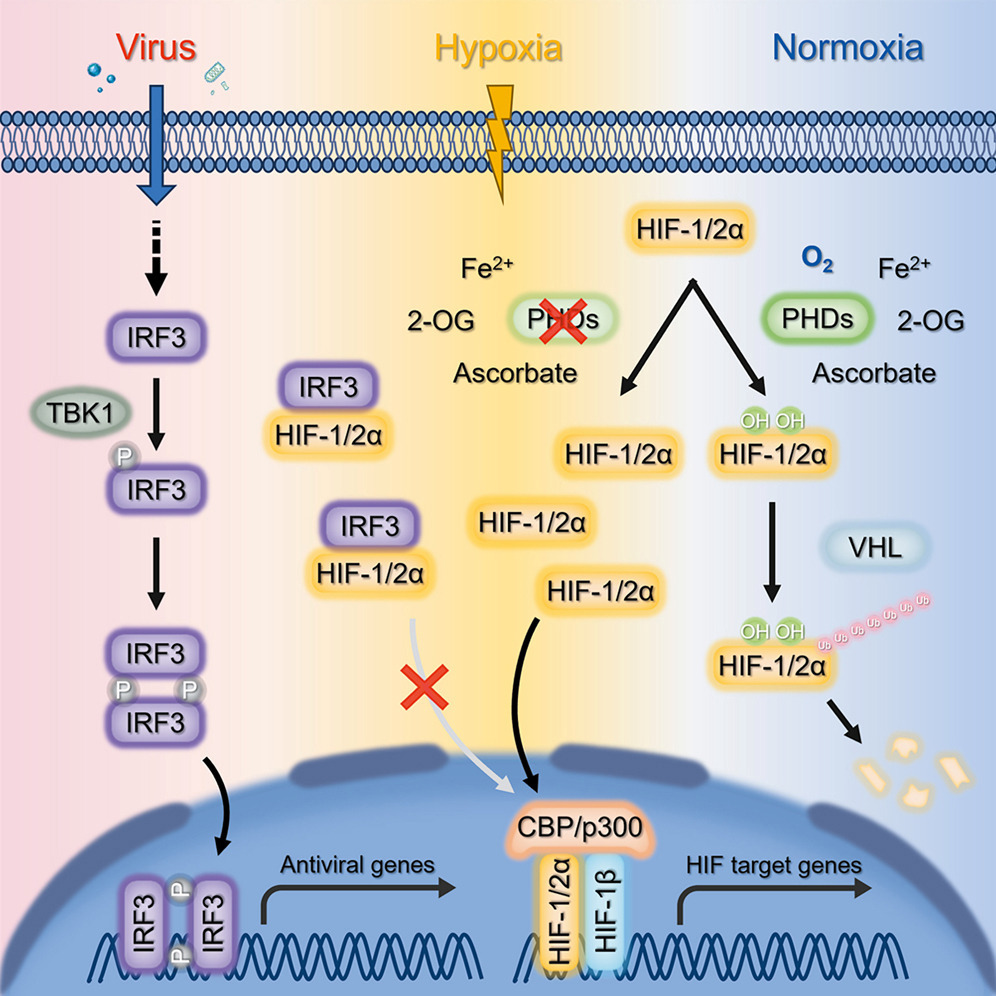
A working model for the role of IRF3 under hypoxic conditions or upon viral infection. (Image by IHB)
<関連情報>
- https://english.cas.cn/newsroom/research-news/202603/t20260305_1151520.shtml
- https://www.cell.com/cell-reports/fulltext/S2211-1247(25)01587-6
IRF3はHIF-αを細胞質内に保持することで低酸素シグナル伝達を弱める IRF3 attenuates hypoxia signaling by retaining HIF-α in the cytoplasm
Hongyan Deng ∙ Shuke Jia ∙ Chunchun Zhu, ∙ … ∙ Jian-Fang Gui ∙ Xing Liu ∙ Wuhan Xiao
Cell Reports Published:January 11, 2026
DOI:https://doi.org/10.1016/j.celrep.2025.116815
Highlights
- IRF3 interacts with HIF-1α and HIF-2α
- Resting cytoplasmic IRF3 retains HIF-α proteins in the cytoplasm
- IRF3 inhibits the transcription factor function of HIF-α
- IRF3 attenuates hypoxia signaling in the resting state
Summary
Interferon regulatory factor 3 (IRF3) functions as a key transcription factor in the innate antiviral immune response, which depends on its nuclear localization. However, its function in the cytoplasm during non-infection states remains largely unknown. In this study, we found that resting cytoplasmic IRF3 interacts with hypoxia-inducible factor (HIF)-1α and HIF-2α, two master regulators of hypoxia signaling. This interaction retains HIF-α in the cytoplasm under hypoxic conditions, preventing it from exerting its transcription factor function and attenuating hypoxia signaling. Disruption of IRF3 in both mice and zebrafish resulted in increased expression of hypoxia response genes and enhanced tolerance to hypoxia. These findings suggest that, in the absence of viral infection, cytoplasmic IRF3 modulates hypoxia signaling by retaining HIF-α in the cytoplasm under hypoxic conditions.