2026-03-31 京都大学iPS細胞研究所
本研究の概要
<関連情報>
- https://www.cira.kyoto-u.ac.jp/j/pressrelease/news/260331-100001.html
- https://www.cell.com/cell-reports-methods/fulltext/S2667-2375(26)00072-X
hiPSCからの後脳様神経幹細胞の誘導および維持のためのWnt活性化と二重SMAD阻害 Wnt activation and dual SMAD inhibition for induction and maintenance of hindbrain-like neural stem cell from hiPSCs
Ziadoon Al-Akashi ∙ Denise Zujur ∙ Nicholas Boyd-Gibbins ∙ … ∙ Asuka Morizane, ∙ Jun Takahashi ∙ Makoto Ikeya
Cell Reports Methods Published:March 30, 2026
DOI:https://doi.org/10.1016/j.crmeth.2026.101372
Motivation
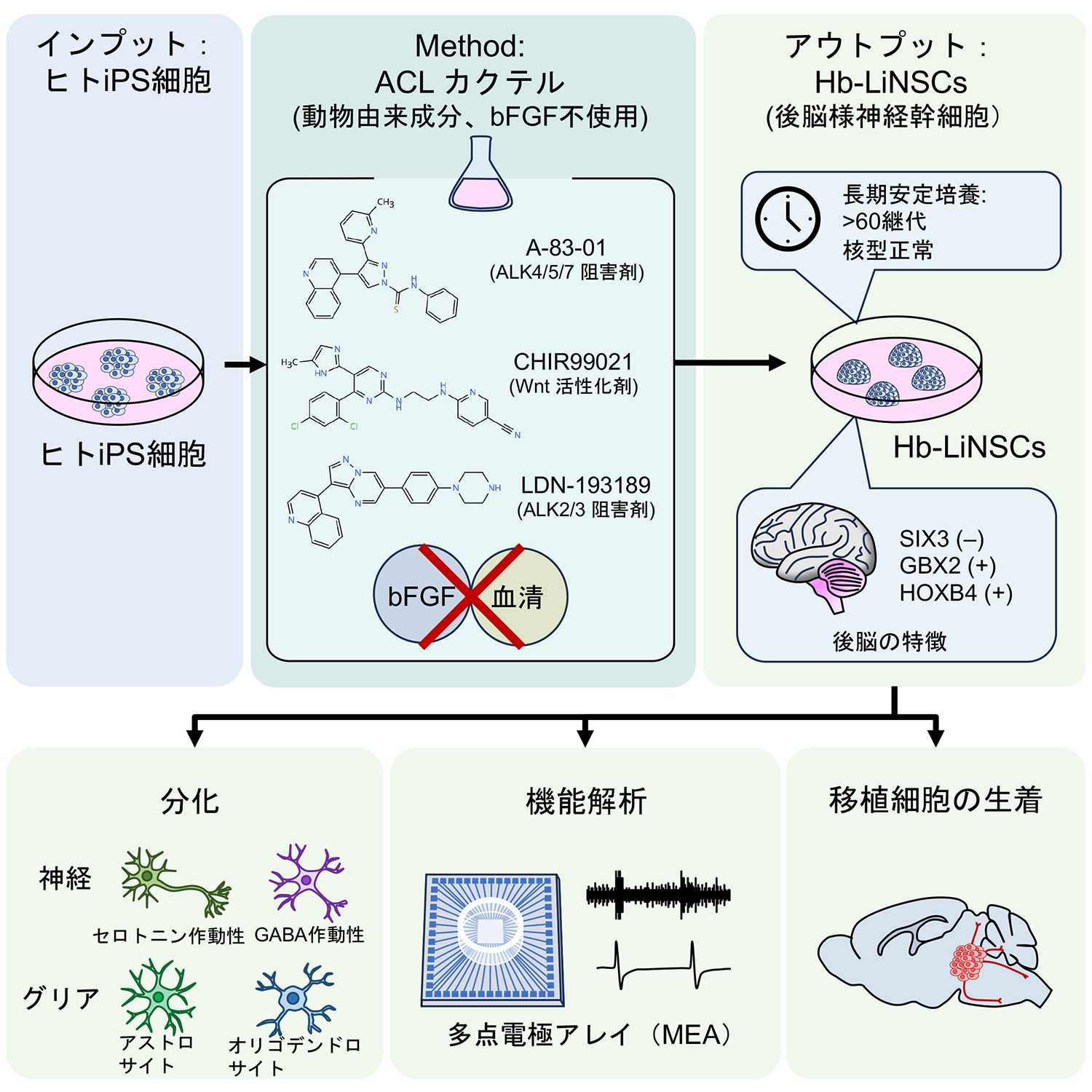
The extraction and expansion of human hindbrain stem cells from human embryos have been reported; however, such methods do not allow cell extraction from patients because of the critical anatomical location and associated ethical constraints. Therefore, we sought to induce human iPSCs into hindbrain-like neural stem cells under minimal conditions that enable scalability and reproducibility.
Highlights
- Hindbrain-like NSCs (Hb-LiNSCs) were induced from hiPSCs using small molecules
- The protocol is xeno- and bFGF-free and ensures high reproducibility
- Hb-LiNSCs maintain regional identity and potency for over 60 weeks of culture
- Differentiated neurons from Hb-LiNSCs show functional network activity in vitro
Summary
Neurons exhibit region-specific identities corresponding to functional distinctions across different brain areas. Region-restricted neural stem cells (NSCs) have previously been generated from pluripotent stem cells; however, maintaining their regional identity over extended passages remains challenging. Here, we report the generation of hindbrain-like induced NSCs (Hb-LiNSCs) with upregulated hindbrain-specific markers and downregulated forebrain, midbrain, and spinal cord markers under xeno-free and basic fibroblast growth factor (bFGF)-free conditions using three chemicals—CHIR99021 (at a high concentration), a potent activator of the Wnt pathway; A-83-01, a potent inhibitor of the TGF-β/Activin/Nodal pathway; and LDN193189, a potent inhibitor of the bone morphogenetic protein pathway. Hb-LiNSCs maintained their chromosomal integrity, multipotency, and differentiation capacity even after long-term culture for more than 60 weeks. This approach enhances our understanding of neurodevelopmental and neurodegenerative processes in the hindbrain region and paves the way for developing targeted cell-based therapy as well as disease modeling for drug discovery.