2026-03-31 東北大学
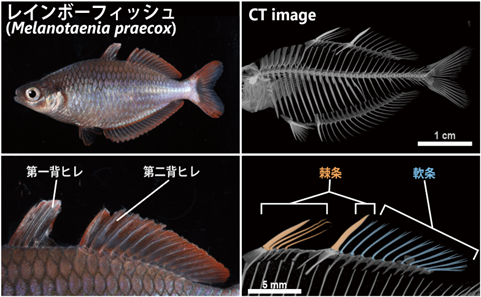
図1 レインボーフィッシュ(成魚)の骨格: 第一背ヒレの全ての骨と第二背ヒレの一番前の骨が棘条になっており、第二背ヒレの2番目以降の骨が全て軟条になっている。
<関連情報>
- https://www.tohoku.ac.jp/japanese/2026/03/press20260331-02-fish.html
- https://www.tohoku.ac.jp/japanese/newimg/pressimg/tohokuuniv-press20260331_02web_fish.pdf
- https://www.nature.com/articles/s41467-026-69180-y
棘条類の発生メカニズムは、棘鰭類の形態的多様化を促進する Actinotrichia-independent developmental mechanisms of spiny rays facilitate the morphological diversification of Acanthomorpha fish fins
Kazuhide Miyamoto,Junpei Kuroda,Satomi Kamimura,Yasuyuki Sasano,Gembu Abe,Satoshi Ansai,Noriko Funayama,Masahiro Uesaka & Koji Tamura
Nature Communications Published:14 February 2026
DOI:https://doi.org/10.1038/s41467-026-69180-y
Abstract
Skeletal forms in vertebrates have been regarded as good models of morphological diversification. Fish fins show great diversity in form, with their supporting skeletal structure being classified into soft rays and spiny rays. In fish evolution, spiny-ray morphologies are known to be sometimes extremely modified; however, it remains unknown how the developmental mechanisms of spiny rays have contributed to their morphological diversification. By using the rainbowfish Melanotaenia praecox for examination of the extracellular matrix (ECM) and cell dynamics of spiny-ray development, we demonstrate that spiny-ray development is independent of the actinotrichia (needle-shaped collagen polymers at the tip of fins), which are known as an important ECM in soft-ray morphogenesis. Furthermore, we found that in the thorny spiny ray of the filefish Stephanolepis cirrhifer, the lateral protrusions are associated with BMP-positive osteoblast condensation, as in the spiny-ray tips in M. praecox and S. cirrhifer. Taken together, our findings reveal that osteoblast distribution and signaling-molecule intensity would contribute to spiny-ray modification. In comparison to soft ray development, the independence from actinotrichia in spiny rays would facilitate growth direction change, leading to their morphological diversification. This suggests that variation in cell distribution and ECM usage may be important contributors to morphological diversification, not only in Acanthomorpha, but also in other animal taxa.