
2026-04-15 パシフィック・ノースウェスト国立研究所(PNNL)
<関連情報>
- https://www.pnnl.gov/publications/predicting-viral-hijacking-through-genome-scale-modeling
- https://www.science.org/doi/10.1126/sciadv.aeb7646
バクテリオファージによる代謝乗っ取りのゲノムスケールモデルにおける相乗効果と拮抗作用 Synergy and antagonism in a genome-scale model of metabolic hijacking by bacteriophages
Jordan C. Rozum, William Sineath, Pavlo Bohutskyi, Jordan Quenneville, […] , and Song Feng
Science Advances Published:1 Apr 2026
DOI:https://doi.org/10.1126/sciadv.aeb7646
Abstract
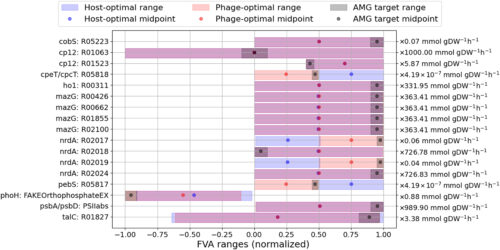
Bacteriophage auxiliary metabolic genes (AMGs) alter host metabolism by hijacking reactions, but previous studies mostly inferred their roles from annotations, ignoring system-wide impacts and phage production. Here we integrate AMGs and phage assembly into a genome-scale metabolic model of Prochloroccocus marinus MED4 infected by P-HM2. We show that 17 directly hijacked reactions substantially affect more than 30% of the reactions in MED4 metabolism, including carbon fixation, photosynthesis, and nucleotide synthesis, distinguishing these AMGs as either phage aligned—shifting feasible reaction velocities in accordance with maximal phage production—or phage antialigned. Pareto optimization reveals that phage-aligned reactions alter phage-host growth trade-offs, while phage-antialigned reactions do not. We experimentally validate our predictions of system-level AMG impacts by measuring the N-dependent effect of P-HM2 cp12 expression on growth in a model relative of the genetically intractable MED4, Synechococcus elongatus. We also show that AMGs’ indirect impacts are synergistically and antagonistically coupled, providing systems-level insight into AMG perturbations and highlighting how nontrivial cascading effects shape host metabolism.

