2026-04-15 ノースカロライナ州立大学(NC State)
<関連情報>
- https://news.ncsu.edu/2026/04/researchers-synthesize-photosynthetic-molecule-found-in-bacteria/
- https://pubs.rsc.org/en/content/articlelanding/2026/sc/d5sc10233b
バクテリオクロロフィルa の合成 Synthesis of bacteriochlorophyll a
Duy TM Chung,Chau Nguyen,Yizhou Liu, and Jonathan S. Lindsey
Chemical Science Published:10 Apr 2026
DOI:https://doi.org/10.1039/D5SC10233B
Abstract
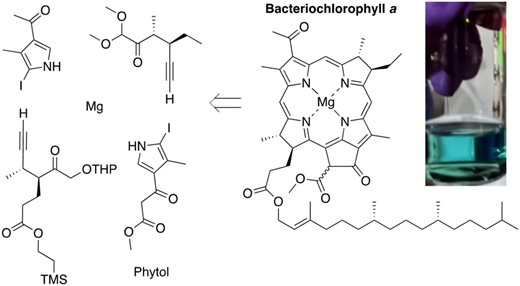
Photosynthetic tetrapyrroles absorb light to power the biosphere but have largely been neglected as targets of chemical synthesis. Bacteriochlorophyll a – a key macrocycle in the bacterial photosynthetic reaction center – contains four stereocenters at the rim of the bacteriochlorin chromophore due to the trans-dialkyl group in each pyrroline ring (B, D), and an epimerizable β-ketoester embedded in the isocyclic ring (E). Here, each pair of stereodefined vicinal substituents was introduced as a chiral 4-nitroalkanal building block, which was converted to an alkynone for subsequent coupling with an iodopyrrole (A, C), affording the AD and BC dihydrodipyrrins. The dihydrodipyrrins were equipped with reactive groups (1-formyl, AD-half; 1-(1,1-dimethoxymethyl) and 8-(3-methoxy-1,3-dioxopropyl, BC-half) suited for directed macrocycle formation. Knoevenagel condensation of AD and BC halves afforded a propenone, the nexus for constructing ring E concomitantly with the macrocycle in the subsequent one-flask, double-ring closure (Nazarov cyclization, electrophilic aromatic substitution, elimination of methanol). The aromatic bacteriopheophorbide was obtained as the 2-trimethylsilylethyl propanoate, which upon acidolysis and esterification with phytol yielded bacteriopheophytin a; subsequent magnesiation gave bacteriochlorophyll a. The modularity of the synthesis, straightforward construction of asymmetric building blocks, and convergent joining of AD and BC halves suggest that the present route may provide an entrée into diverse photosynthetic macrocycles.